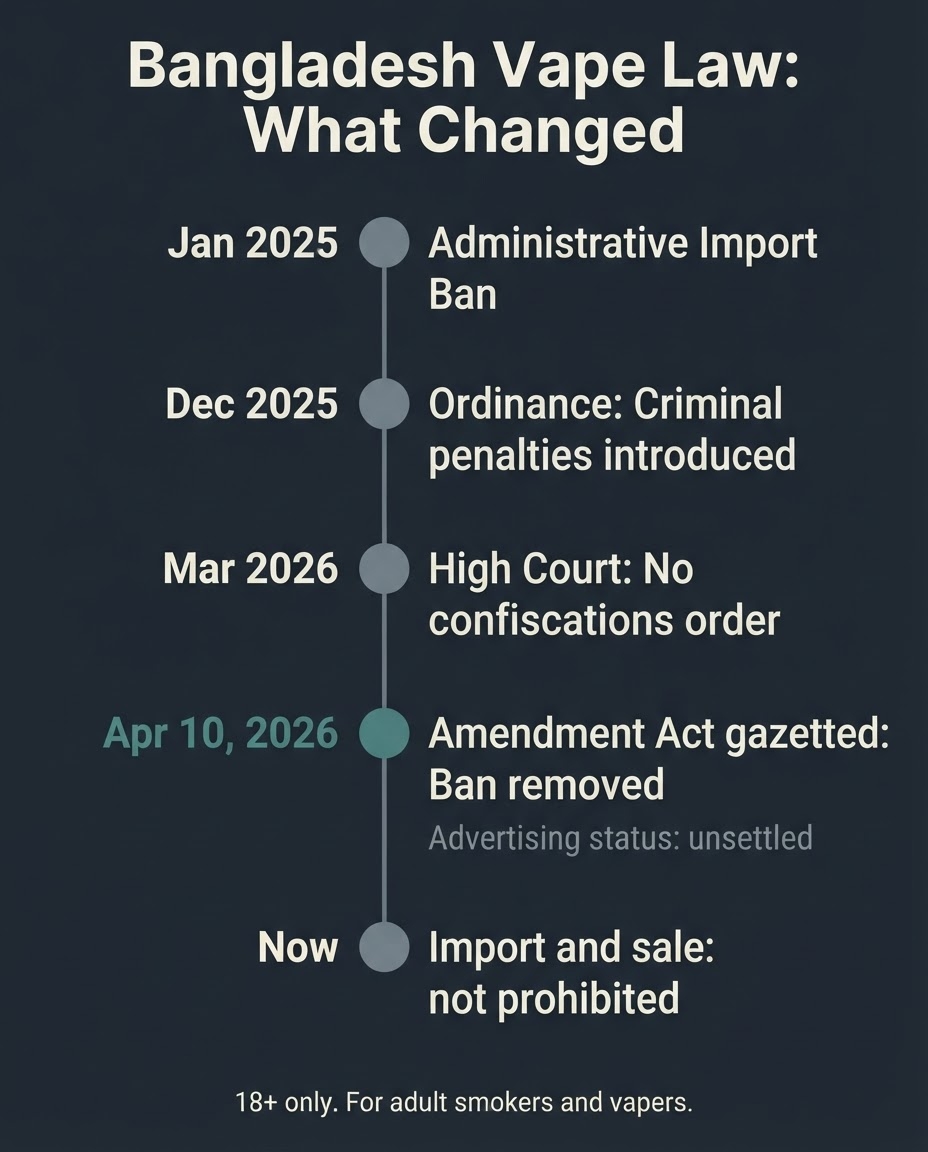
Bangladesh has changed its vape import laws three times in eighteen months. The December 2025 ordinance banned everything. The High Court challenged that ban in March 2026. Parliament then reversed the ban in April 2026. If you read news at any single point in that sequence and stopped, you currently hold incorrect information. This article explains where the law actually stands as of mid-2026, what the customs position is for importers and retailers, and what adults buying legal vape products in Bangladesh need to understand.
As of 10 April 2026, vaping is not banned in Bangladesh. The Smoking and Tobacco Products Usage (Control) (Amendment) Act, 2026, gazetted that date, removed the e-cigarette prohibition that had been introduced by the December 2025 ordinance. Retail sale and import of e-cigarettes, pod systems, and e-liquids are not prohibited by current statute. Vape hardware is classified under HS code 8543.40.00 at Bangladesh Customs, carrying a customs duty of 25%, supplementary duty of 100%, VAT of 15%, and additional levies; importers should verify the current Total Tax Incidence with NBR directly. A broad advertising ban applies to tobacco products under the 2026 Act; whether it extends to e-cigarettes is legally unsettled and has not been confirmed by a Bangladeshi court or the NBR.
The Regulatory Timeline: What Actually Happened
Understanding the current legal position requires knowing the sequence, because each step was a response to the step before it.
Bangladesh has had a tobacco control law since 2005 and amended it in 2013. Neither version specifically addressed electronic cigarettes. Products existed in a legal grey zone for more than a decade. A 2023 study published in PLOS ONE mapped 276 e-cigarette retail points of sale across Dhaka city, finding them concentrated in shopping malls in areas including Uttara, Mirpur, Gulshan, and the Adabar-Mohammadpur corridor — products sold openly and without any specific statutory framework governing them.
In January 2025, the interim government imposed an administrative import ban on ENDS products. This was tightened substantially on 23 December 2025, when the Smoking and Tobacco Products Usage (Control) (Amendment) Ordinance, 2025, was gazetted. That ordinance was direct. Under Section 6(Ga), it prohibited the production, import, export, storage, advertising, promotion, sponsorship, marketing, distribution, sale, and transport of electronic nicotine delivery systems, their components, e-cigarettes, vape devices, vaporisers, and e-liquids, as well as heated tobacco products and any emerging tobacco products. Penalties ran to three months’ imprisonment, fines up to 2,00,000 BDT, or both, doubling for repeat offences.
At that point, every vape device, pod, and bottle of e-liquid in Bangladesh was technically illegal to sell, hold, or transport.
Before that ordinance could be fully enforced, forty-one vape importers petitioned the High Court. On 1 March 2026, a bench of Justice Ahmed Sohel and Justice Fatema Anwar issued a rule questioning whether Section 6(Ga) was constitutional, directing the government not to confiscate or seize vapes that had been lawfully imported. The petitioners argued the provision was discriminatory: it banned a product that many countries recognise as a harm-reduction tool for existing smokers, while leaving conventional cigarettes fully legal.
That court order was still in effect when parliament acted. A special committee reviewing 133 ordinances of the interim government recommended removing the e-cigarette provisions. Parliament accepted the recommendation unanimously. The Smoking and Tobacco Products Usage (Control) (Amendment) Act, 2026, was gazetted on 10 April 2026. The Section 6(Ga) prohibition on e-cigarettes was gone.
What the 2026 Act Does and Does Not Do
The April 2026 Act is not a vaping-friendly document. It contains some of the strongest tobacco control measures Bangladesh has ever enacted. What it does not do, as of its gazetted text, is apply those measures to e-cigarettes.
The Act’s significant provisions include: a comprehensive ban on tobacco advertising, promotion, and display across print, electronic, digital, and social media, entertainment platforms, and points of sale; a requirement that tobacco packaging carry pictorial health warnings covering 75% of the front and back; a prohibition on tobacco sales within 100 metres of schools, hospitals, children’s parks, and sports venues; and the removal of designated smoking areas in public places.
According to Health Policy Watch’s analysis of the Act published 20 April 2026: “The law does not cover newer tobacco and nicotine products, including vapes, heated tobacco products, electronic nicotine delivery systems and nicotine pouches.”
This is the critical point for any retailer or importer. The advertising ban, the point-of-sale display ban, the proximity restriction — these provisions, as currently written, apply to tobacco products. E-cigarettes were removed from the Act’s scope when the ENDS clauses were stripped out.
Whether a court would read the advertising prohibition as extending to e-cigarettes by some other interpretive route is a question that has not been answered. The Tobacco Control Laws organisation, which catalogues these statutes internationally, notes the 2026 Act has not yet been reviewed by its legal staff. KandyVape has not received independent Bangladeshi legal confirmation on this point. Until that confirmation exists, all content we publish — including this article — is written in educational and informational register, not as advertising. That is not a technicality; it is the correct legal posture for a retailer operating in an unsettled legal environment.
The Customs Position: HS Code, Duty, and What Importers Face
Removing the statutory ban does not remove the financial reality of importing vape products into Bangladesh. These are taxed heavily.
Vape hardware — pod systems, box mods, vape kits, and similar devices — is classified under HS code 8543.40.00 at Bangladesh Customs: “Electronic cigarettes and similar personal electric vaporising devices.” The Bangladesh Customs Operative Tariff for this HS code shows the following levy components:
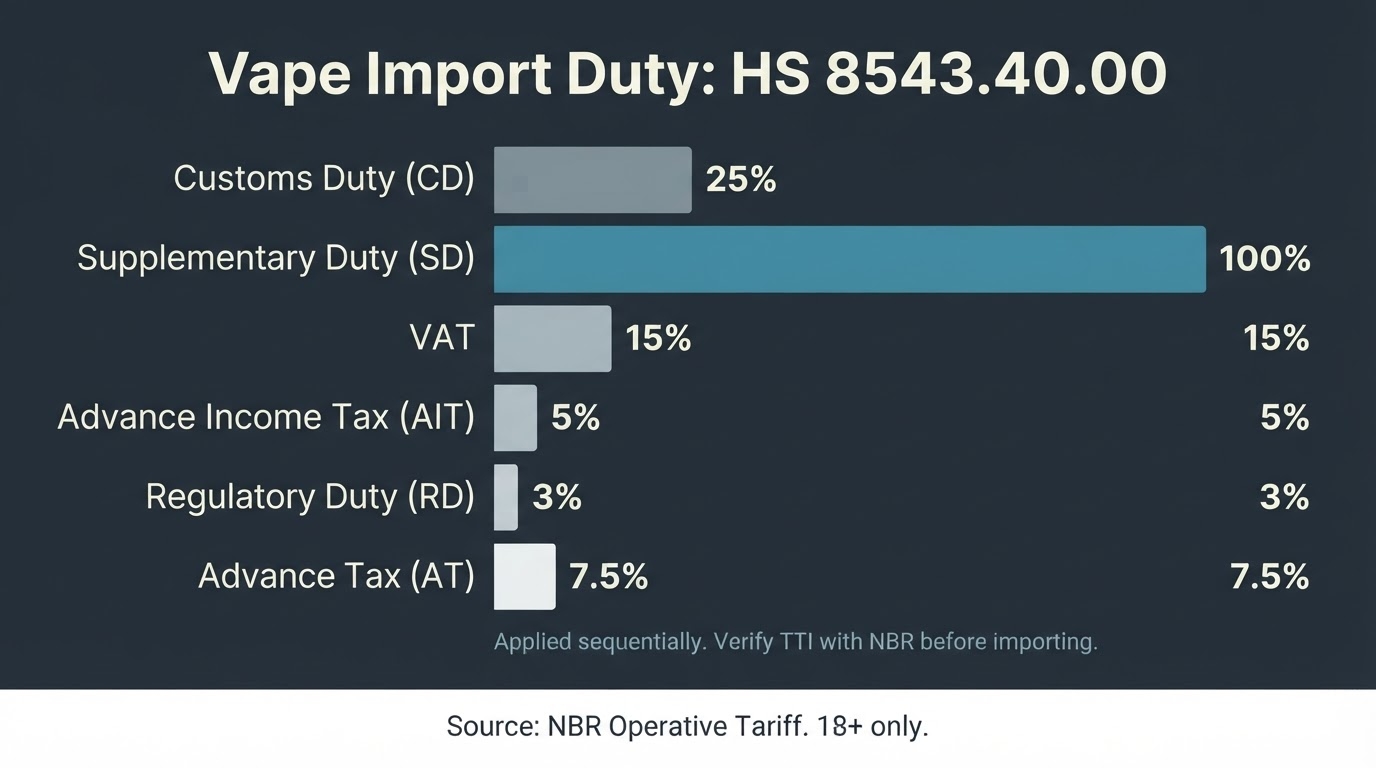
| Levy | Rate |
| Customs Duty (CD) | 25% |
| Supplementary Duty (SD) | 100% |
| Value Added Tax (VAT) | 15% |
| Advance Income Tax (AIT) | 5% |
| Regulatory Duty (RD) | 3% |
| Advance Tax (AT) | 7.5% |
These levies are applied sequentially, not additively in a simple sum, which means the Total Tax Incidence (TTI) is significantly higher than the headline CD rate suggests. Importers should verify the current TTI directly with the National Board of Revenue or a licensed customs clearing agent before placing any shipment. The 2026-2027 tariff year schedule was published by Bangladesh Customs (customs.gov.bd) in June 2026; the exact TTI figure for HS 8543.40.00 in that schedule should be confirmed against that document rather than assumed from prior year figures.
E-liquid and nicotine-containing components may carry separate, potentially higher supplementary duty rates. A 2023 budget proposal reported by TBS News cited 150% SD on liquid nicotine imports and a total tax incidence on e-cigarette parts proposed at 212.2%. Whether those specific rates were enacted and remain in force under the 2026-2027 tariff requires direct verification with NBR or a customs agent. We state that explicitly because quoting a rate that was proposed but not enacted, or that changed in this year’s tariff, would give an importer incorrect information they cannot act on safely.
The practical effect of the duty structure is visible in retail pricing. A device that costs USD 30 at source in China or the USA arrives at a landed cost considerably higher after customs clearance, freight, and agent fees. When you see a device priced substantially lower than what a licensed Bangladeshi importer charges, the gap is explained by one of three things: the device cleared customs under a different HS code, it was under-declared in value, or it did not clear customs at all. Those are not the same risk. The third category is a clone or grey-market unit with no documented chain of custody and no recourse if the chipset fails.
Import Documentation: What a Legal Vape Importer Needs
Removing the statutory ban restores the pre-ban documentation requirement. A legal commercial importer of vape products in Bangladesh needs:
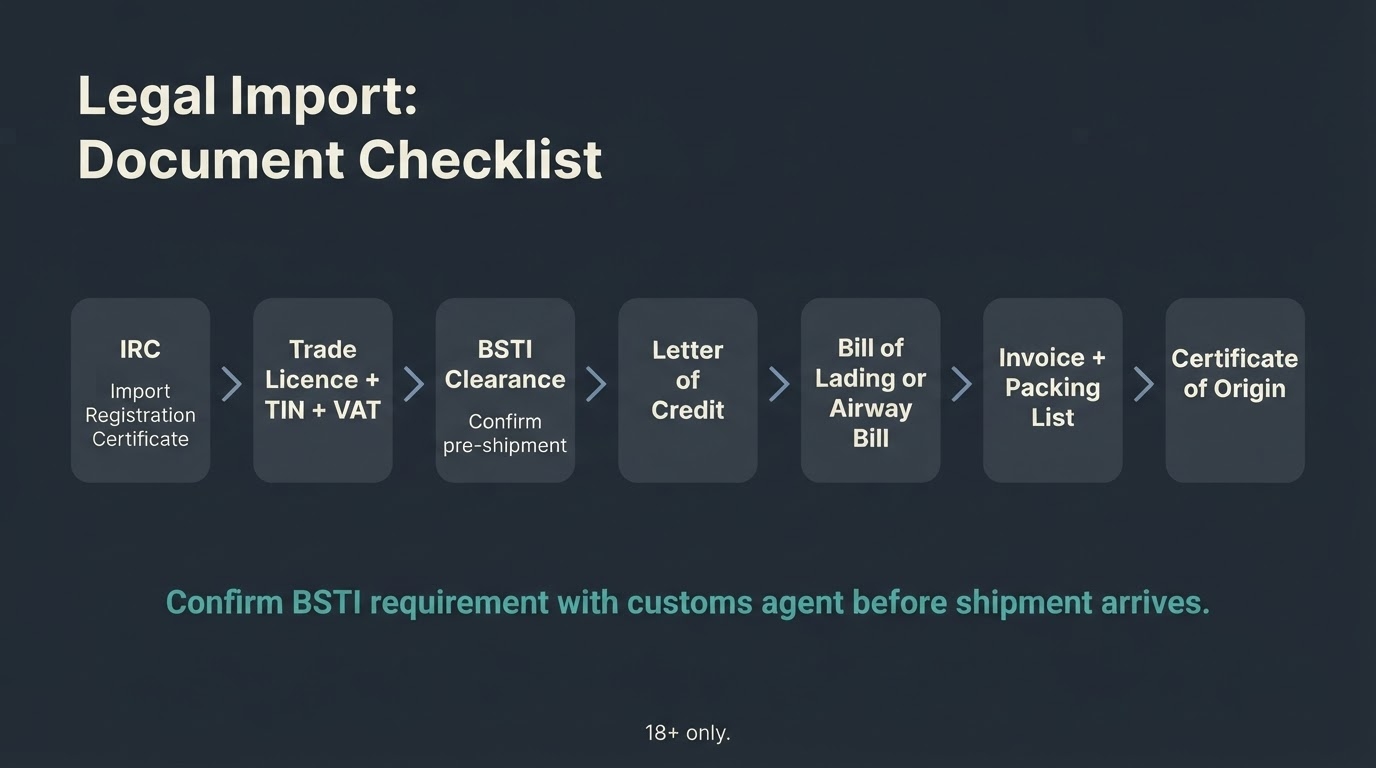
An Import Registration Certificate (IRC) from the relevant authority. IRC applications require a valid trade licence, a Tax Identification Number (TIN), VAT registration, and bank certification, among other documents. Individuals importing for personal use operate under different traveller allowance rules and should check current HSIA customs guidance directly.
BSTI (Bangladesh Standards and Testing Institution) clearance is required for electronics and consumer goods imported commercially. Whether vape hardware requires BSTI certification specifically, or whether it falls under a general electronics clearance process, should be confirmed with BSTI or a licensed import agent before shipment arrives at port. Customs clearance without the required BSTI documentation will hold a shipment.
A letter of credit, bill of lading or airway bill, commercial invoice, packing list, and certificate of origin are standard import documents regardless of product category.
We operate as [CONFIRM: authorised retailer / official distributor] for Vaporesso, Uwell, Doozy, and Perfect Vape. That means our imported stock arrives with manufacturer documentation, correct HS classification, and cleared customs. A device that arrives in Bangladesh without that chain of documentation is a device you cannot verify and cannot return if it fails.
The Advertising Question: What Retailers Must Understand
This section is written for retailers and importers, not for end consumers choosing a device.
The 2026 Act’s advertising prohibition is broad. It covers tobacco products across print, electronic, digital, and social media, entertainment platforms, and points of sale. The Campaign for Tobacco-Free Kids, commenting on the Act’s passage, described the provisions as a comprehensive ban on tobacco advertising including on online and digital platforms.
Since e-cigarettes are not defined as tobacco products in the 2026 Act as gazetted — the ENDS clauses having been removed — the advertising prohibition does not on its face apply to e-cigarettes. However, the Bangladesh FCTC obligation remains. Bangladesh signed the WHO Framework Convention on Tobacco Control in 2003. Under Article 13 of the FCTC, parties are required to implement a comprehensive ban on tobacco advertising, promotion, and sponsorship. Anti-tobacco advocates have argued that removing e-cigarettes from the Act’s scope while retaining the FCTC obligations creates a regulatory inconsistency that may be tested in court.
What this means in practice for a retailer: writing content that explains how a device works, what its specifications are, how to select the right coil, and what the legal import process looks like is educational content. Writing “buy this now, best deal in Dhaka, limited stock” is promotional content. The former is defensible under any reasonable reading of the current legal framework. The latter is not, until the advertising question is resolved by a legal review or a court ruling.
This article is educational. The product pages on our website are informational. That is not an accident.
What the WHO and UNICEF Have Said
We are required by our own editorial standards to attribute health statements to named bodies rather than assert them. Here is what the relevant bodies have said.
According to the WHO’s Global Tobacco Epidemic Report 2021, e-cigarettes contain nicotine, which is highly addictive and can severely harm brain development in children and adolescents. The WHO also states that people who use e-cigarettes are twice as likely to start using conventional cigarettes in the future. Those statements are the WHO’s conclusions, not ours.
In a joint letter to Bangladesh’s health ministry on 9 April 2026, WHO and UNICEF raised concern about the lifting of the import ban, stating that e-cigarettes are leading young people into nicotine addiction that is harmful to brain development and poses long-term mental health risks. As reported by Prothom Alo’s English edition, the WHO-UNICEF letter also noted that the growing availability of new nicotine products could increase tobacco-related deaths and the overall economic burden.
Public health experts quoted in the same report, including Professor Sohel Reza Choudhury of the National Heart Foundation Hospital, stated that nicotine intake from e-cigarettes can in some cases be higher than from conventional cigarettes, because devices are used repeatedly and over longer periods.
These are the positions of named health authorities. We report them because an adult making a decision about nicotine products deserves access to what health bodies say about those products, not a filtered version that supports a sale.
Authenticity and the Legal Market
Every product we stock comes from an authorised supply chain. That matters for a reason that is specific to this legal environment.
When the import ban was in effect from December 2025 to April 2026, no legal import route existed for vape products. The stock that continued moving during that period moved through informal channels: personal luggage, undeclared commercial shipments, or grey-market distributors. Some of that stock is now in circulation in Dhaka’s retail market. It may be authentic hardware that simply arrived informally. It may be counterfeit hardware that was mixed in with informal stock during a period when no one was checking documentation carefully. You cannot tell from looking at the box.
What you can check: the manufacturer’s authenticity verification system. Vaporesso, Uwell, and other major brands print a scratch-off code on the box. Before paying for any device from any seller, including us, scratch that code and enter it on the manufacturer’s verification page. The code on a genuine device is unique and will only verify once. A clone will fail, or will return an “already verified” result if the code was copied from a genuine unit.
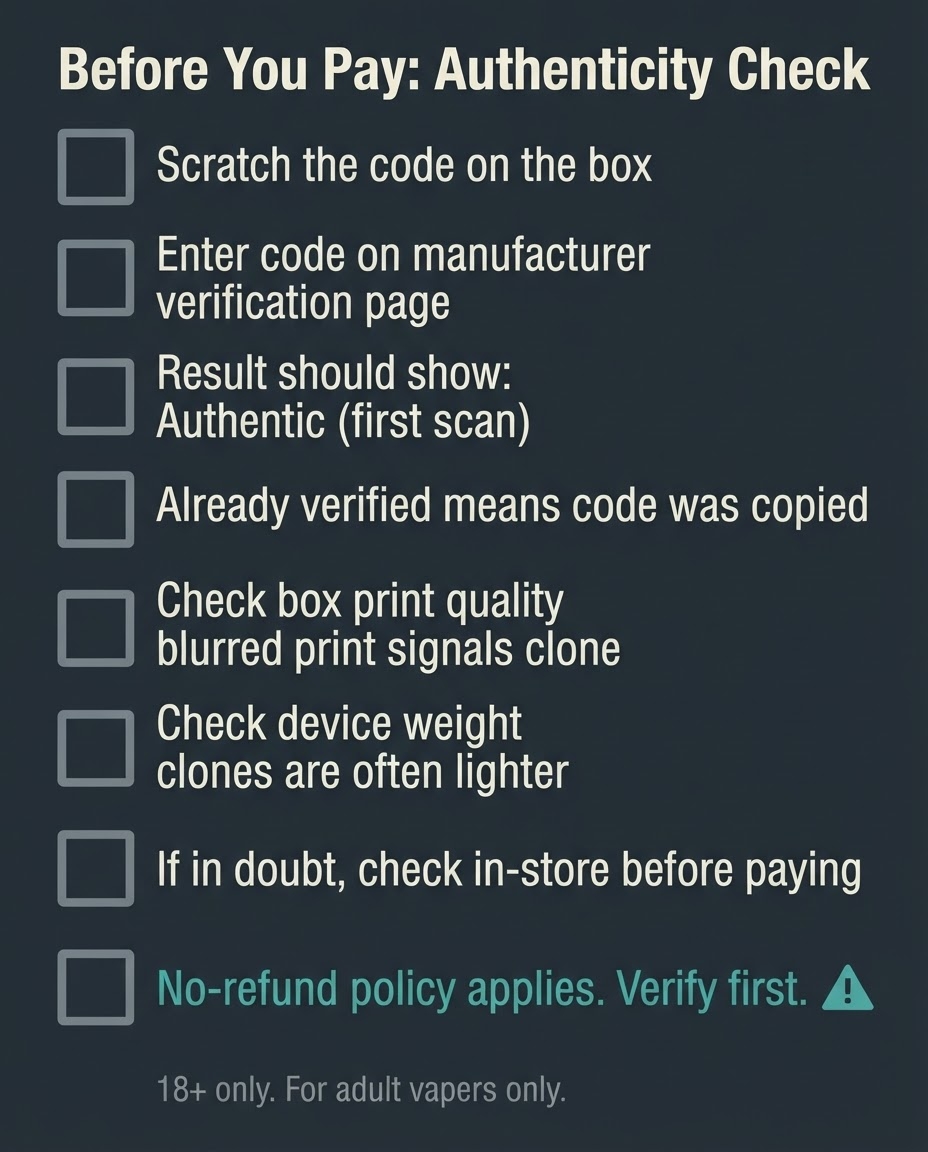
We stock what we can stand behind. We also suggest you verify it anyway. A no-refund store that tells you to verify independently is a store that is not afraid of what you will find.
What This Means for Adult Smokers Considering Vaping
If you are an existing adult smoker in Bangladesh and you have been waiting for legal clarity before deciding whether to try a vape device, the legal position as of April 2026 is that purchase and use are not prohibited. The import and retail market has been reopened.
What has not changed is the absence of a specific regulatory framework governing vape products in Bangladesh. There are no product safety standards specific to e-cigarettes, no maximum nicotine strength regulations, and no mandatory ingredient disclosure rules specific to ENDS as of the gazetted 2026 Act. That absence of regulation cuts both ways: it means legal products are available, and it also means products with no quality control are available from the same market.
The practical implication: the question “is it legal to buy?” has a clear answer. The question “is the specific product I am buying safe?” depends on who made it, how it was imported, and what is in the e-liquid. Those questions are answered by choosing brands with verified supply chains and checking authenticity codes before paying.
Our is the reason this article is as detailed as it is. A wrong decision about a device or a coil that you cannot return is a real financial loss. We write to prevent that.
Frequently Asked Questions
Is vaping legal in Bangladesh in 2026?
As of 10 April 2026, yes. The Smoking and Tobacco Products Usage (Control) (Amendment) Act, 2026, gazetted on that date, removed the provisions that had banned e-cigarettes, vape devices, and ENDS products under the December 2025 ordinance. Retail sale and commercial import are not currently prohibited by statute. The advertising and promotion position is legally unsettled and a separate question from legality of sale.
What happened to the December 2025 vape ban?
The December 2025 ordinance introduced criminal penalties for importing, selling, or transporting vapes. A parliamentary special committee, reviewing 133 ordinances of the interim government, recommended removing those provisions. Parliament passed the 2026 Amendment Act unanimously, stripping the e-cigarette clauses from the law. The ordinance’s vape-specific provisions were superseded.
Can I personally bring a vape through Hazrat Shahjalal Airport?
Bangladesh Customs publishes personal traveller allowances for HSIA. As of January 2025, those allowances covered cigarettes and cigars but were written before e-cigarettes had clear legal status. Since the April 2026 Act does not prohibit e-cigarettes, personal travel with a device is no longer a statutory offence. However, travellers carrying devices with lithium batteries must comply with IATA airline rules, which require batteries in carry-on luggage. We recommend checking current HSIA customs guidance directly, since traveller allowance documents may not yet reflect the April 2026 change.
What customs duty applies to imported vape devices?
Vape hardware falls under HS code 8543.40.00 at Bangladesh Customs. The levy components confirmed from the NBR Operative Tariff include a customs duty of 25%, supplementary duty of 100%, VAT of 15%, advance income tax of 5%, regulatory duty of 3%, and advance tax of 7.5%. These are applied sequentially. The Total Tax Incidence is significantly higher than the CD rate alone. Verify the current TTI for the 2026-2027 tariff year directly with NBR or a licensed customs agent, as tariff schedules are updated annually.
If I order from KandyVape, when will my order arrive?
We dispatch daily at 3:00 PM, including weekends. Orders placed before 3:00 PM on any day go out the same afternoon. Delivery windows and charges within Dhaka and outside Dhaka are listed on our Orders of 3,500 BDT and above qualify for free shipping.
What if the device I buy does not work or does not suit me?
KandyVape operates a strict no-return, no-refund policy on all products. [CONFIRM: state any exception here if one exists, e.g. dead-on-arrival checked in-store within 24 hours.] This is why we write detailed product information, compatibility guides, and regulatory explainers: we would rather you make the right decision once than buy the wrong product with no recourse. If you are uncertain about a device, the counter at Shop #22, Level #3, Sahabuddin Plaza, Adabar, Mohammadpur will let you look at the hardware before committing.
Are there any product regulations specifically for e-cigarettes in Bangladesh beyond import rules?
No specific product safety standards, maximum nicotine strength limits, or mandatory ingredient disclosure rules exist for e-cigarettes in Bangladesh as of the gazetted April 2026 Act. The Act focuses on tobacco product advertising, packaging, and smoke-free provisions. E-cigarette-specific product regulation is not currently in the Act. This differs from the UK, where the MHRA regulates nicotine-containing products, and Australia, where the TGA requires prescriptions for nicotine. Bangladesh’s vape product market is, as of 2026, governed primarily by general consumer protection and import law rather than ENDS-specific product standards.
If You Want to Confirm Before Ordering
The legal position is clear. The regulatory environment is still developing. Before ordering any device, take two minutes to check the manufacturer’s authenticity code on the box. Before ordering a coil for a device you already own, confirm the coil series is confirmed compatible — not just the brand. If you are in Dhaka, the shop at Shop #22, Level #3, Sahabuddin Plaza, Adabar, Mohammadpur 1207 is open for a counter conversation. If you want to order before the 3:00 PM daily dispatch, place your order online. Both options exist for the same reason: to give you accurate information before you spend money you cannot get back.