If you are getting a burnt taste after three days, this guide will tell you exactly why. If your coil has lasted three weeks and you are wondering whether to change it before something goes wrong, this guide covers that too. The answer to “how often to replace your vape coil” is not a single number. It is a range, and the variables that move it around are specific enough that naming them is the only honest way to answer the question.
KandyVape operates a strict no-refund policy on all products. That is not a throwaway line in small print. It is the reason this guide exists at the level of detail it does. A customer who buys the wrong coil, or runs the right coil the wrong way, cannot send it back. We would rather you read this first.
Most vape coils last between 7 and 28 days depending on vaping frequency, wattage, and e-liquid composition. The primary signs a coil needs replacing are: a persistent burnt taste, muted or absent flavour, gurgling or leaking, visibly darkened e-liquid, and discoloured (brown or black) cotton visible through the wicking ports. Running a coil above its rated wattage or using high-sweetener e-liquid are the two most common causes of premature coil failure. Coil-specific wattage ranges are printed on the coil or pod packaging and should be checked before first use.
What a Vape Coil Actually Does, and Why It Wears Out
A coil is a small resistance element, wire or mesh, wrapped in or pressed against absorbent cotton. When the device fires, current flows through the metal and heat transfers into the saturated cotton, vaporising the e-liquid held in the fibres. Every time that happens, two things occur simultaneously: the metal heats and cools, expanding and contracting microscopically, and a small fraction of the e-liquid residue that does not fully vaporise stays behind, baked onto the mesh or wire surface.
Over time, that residue accumulates. It insulates the heat element unevenly, creating hot spots. It blocks wicking ports, starving the cotton of liquid. It alters the flavour of everything that passes through it. Eventually, the coil cannot wick fast enough to keep the cotton wet, and you get a dry hit. That is the physical story of a coil wearing out. Understanding it matters because the rate at which it happens is entirely in your control.
The process is accelerated by three things above all others: running the coil hotter than its rated range, using e-liquid with a VG content too thick for the coil’s wicking ports to handle at the device’s wattage, and vaping e-liquids that contain high concentrations of sweeteners, which caramelise on the mesh surface rather than vaporising cleanly.
The Real Lifespan Range, With the Variables Named
Vaporesso states on its coil maintenance guide that most coils last approximately one to two weeks with average use. Uwell, on their Caliburn coil guidance page, notes the same general window. Neither figure is wrong. Neither figure is useful on its own without the variables attached.
Here is what moves the range:
Wattage relative to the coil’s rated range. Every coil has a wattage window printed on its packaging or body. The Vaporesso GTX 0.8Ω mesh coil, for example, is rated by Vaporesso at 12 to 16W with a best wattage of 16W. Run it at 12W and it will under-vaporise and potentially flood. Run it at 20W and you will burn through cotton in days, not weeks. The wattage printed on the coil is not a suggestion. It is the thermal range the cotton is engineered to handle.
E-liquid VG/PG ratio relative to the coil’s resistance. Propylene glycol (PG) is a thinner carrier that wicks faster through cotton. Vegetable glycerin (VG) is thicker, producing more vapour but moving more slowly through wicking ports. PubChem classifies propylene glycol as a synthetic liquid substance used as a carrier in food and pharmaceutical applications and it is the thinner component in any e-liquid blend. Higher-resistance MTL coils (0.8Ω and above) have narrower wicking ports designed for 50/50 or 60/40 PG/VG ratios. Pour a high-VG 30/70 blend through a 1.2Ω MTL coil and the cotton cannot pull liquid fast enough to stay saturated. The result is a dry hit within the first few sessions, and a coil that looks like it has been used for three weeks after two days.
Sweetener content in the e-liquid. This is the most underappreciated coil-killer. Sucralose and similar sweeteners used in flavoured e-liquids do not fully vaporise at vaping temperatures. They caramelise and deposit as dark, sticky residue on the mesh or wire surface. A coil that would last 14 days on an unflavoured or lightly flavoured liquid may last 5 days on a heavily sweetened profile. If you notice your e-liquid darkening in the pod or tank faster than normal, sweetener gunking is almost certainly the cause. Switching to lower-sweetener liquids is the single most effective way to extend coil life without changing anything else about your setup.
Usage pattern. Vaping continuously in sessions without pause does not allow the cotton to re-saturate between draws. The cotton heats faster than it refills, and the dry sections burn. Short draws with three to five seconds between them give the wicking ports time to pull liquid from the pod or tank. Chain vaping with no pause interval will reliably halve the coil’s functional life.
Starting liquid level. A pod or tank that has run below the wicking port level exposes cotton directly to the heating element with no e-liquid buffer. A single dry hit at this point can char the cotton irreversibly. The coil is functionally finished, even if it has only been in use for two days. Keep your pod at least one-quarter full at all times.
Putting those variables together:
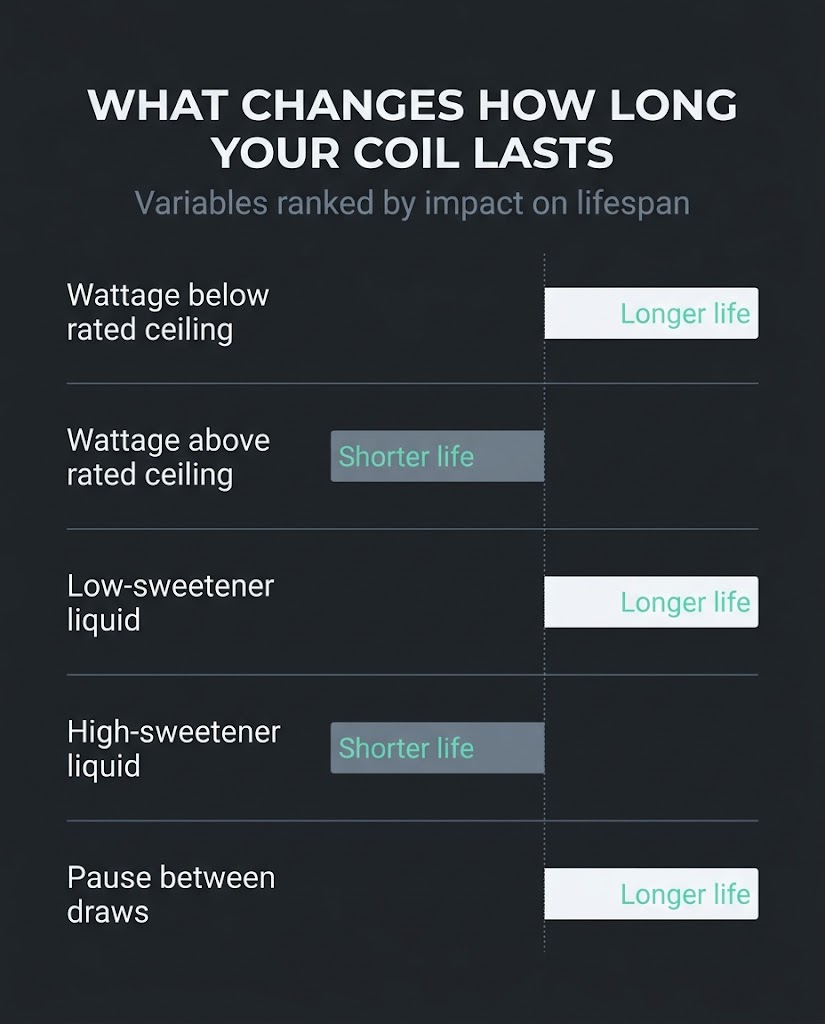
| Variable | Effect on Lifespan | Direction |
| Running at the low end of the wattage range | Cotton stays cooler, less stress per puff | Longer life |
| Running above the rated wattage ceiling | Cotton scorches, mesh oxidises faster | Shorter life |
| 50/50 PG/VG in an MTL coil | Appropriate wick saturation speed | Neutral to longer |
| 70/30 VG/PG in an MTL coil | Slow wicking, dry hit risk | Shorter life |
| High-sweetener e-liquid | Sucralose deposits on mesh surface | Shorter life |
| Low-sweetener or unflavoured liquid | Minimal deposit accumulation | Longer life |
| Consistent pause between draws | Cotton re-saturates between firings | Longer life |
| Chain vaping without pause | Cotton runs dry at firing point | Shorter life |
| Keeping liquid level above wicking ports | Cotton always saturated | Longer life |
| Allowing liquid level to drop below ports | Dry cotton at firing temperature | Much shorter life |
Coil Resistance, Device Class, and Why They Have to Match
This is the section that costs people money. The resistance of a coil determines what class of device it belongs in, what e-liquid viscosity it needs, and what nicotine strength is appropriate for it. Mismatch any one of these three and you will burn coils faster than expected and get a poor experience while doing it.
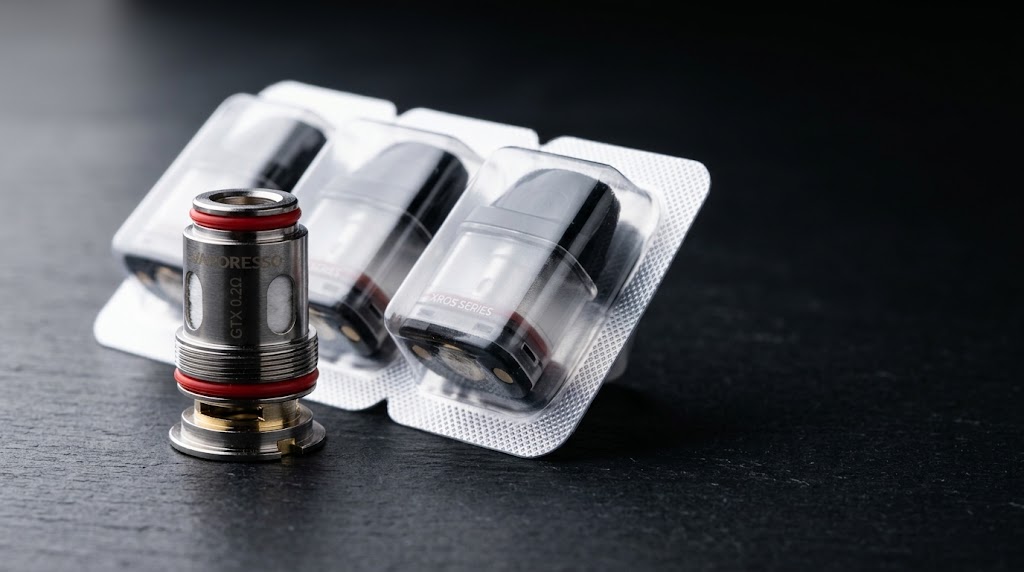
The GTX platform coils from Vaporesso illustrate this clearly. According to Vaporesso’s official coil specification page, the GTX platform spans from 0.15Ω to 1.2Ω. The 0.15Ω and 0.2Ω variants run at 60W and above. They are DTL coils for high-powered mods, paired with high-VG 0mg to 6mg freebase liquid. Put a 0.15Ω coil in a 25W device and it will never reach operating temperature. It will gurgle, spit, and flood constantly, because it needs far more heat than that device can produce. The coil will appear defective. It is not. It is in the wrong device.
At the other end of the range, the GTX 1.2Ω MTL coil runs at 8 to 12W with a best wattage of 11W. Vaporesso rates it for 20mg to 50mg salt nicotine with a 50/50 PG/VG ratio. This is a coil for MTL pod systems, matched to nicotine salt liquids for the draw experience closest to a cigarette. Running 3mg freebase in a 70/30 VG/PG blend through this coil produces a thin, flavourless draw and a waterlogged pod, because the coil’s wattage range cannot vaporise thick VG efficiently and the 3mg nicotine concentration produces no satisfying hit at 11W.
The XROS Series pods follow the same logic. Vaporesso’s official XROS pod specification page shows the 0.4Ω pod with a best wattage of 25W and the 1.2Ω pod at 10W. The 0.4Ω pod is an RDL draw suited to freebase or lower-strength salt. The 1.2Ω pod is a tighter MTL draw suited to 20mg to 50mg salt nicotine. Using 50mg salt in a 0.4Ω pod produces a throat hit that most people cannot tolerate for more than a day. The coil itself is not at fault. The pairing is wrong.
For the Uwell Caliburn G3, the three coil variants are 0.6Ω, 0.9Ω, and 1.2Ω, all integrated into the cartridge (you replace the entire pod, not an insert). The device outputs a maximum of 25W. Per Uwell’s official product page, these are FeCrAl meshed integrated coil cartridges with 2.5ml capacity (2ml for TPD-version markets). Uwell notes on their coil guidance page that higher wattages burn coils out faster, and that high-VG e-liquids can shorten pod life by reducing wicking efficiency. The G3 is a MTL-oriented device; it performs best with 50/50 or higher-PG liquids and nicotine salt at appropriate strengths for MTL use.
Nicotine salt and resistance pairing is the most common mistake we see. 50mg salt nicotine in a 0.4Ω or 0.6Ω pod running at 20W or above delivers a throat hit severe enough that most users abandon the setup within a week, blaming the device. The device is running correctly. The nicotine concentration is wrong for that resistance class. We would rather explain that here than sell you a coil pack you cannot return.
The Warning Signs: What to Look For
These are observable. None require guesswork. When more than one appears together, change the coil.
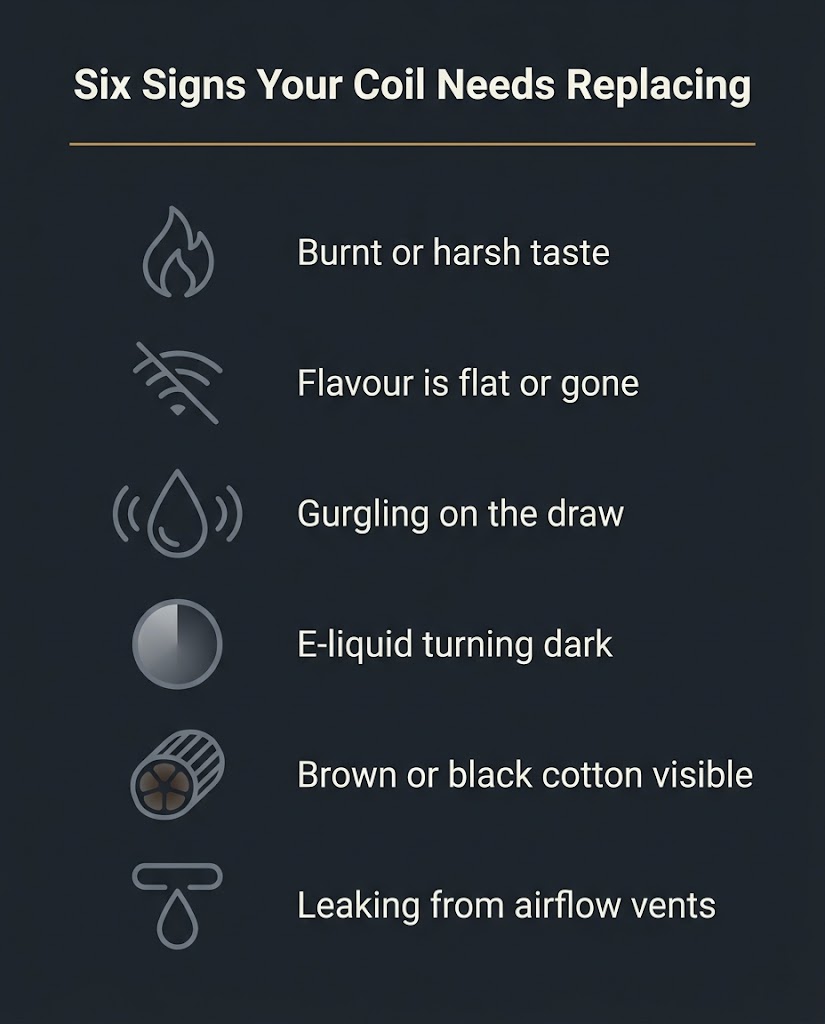
Burnt taste or harsh metallic hit. This is the clearest signal and the one that demands an immediate response. A burnt taste means the cotton is charred or the mesh is oxidised at a hot spot. Do not continue vaping from a coil that tastes burnt. The cotton is no longer functioning as a clean wicking medium and you are drawing combustion byproducts.
Muted or absent flavour. This happens before the burnt taste in most cases. Residue accumulation on the mesh surface changes the heat transfer profile and dulls the flavour delivery. If a liquid you know well suddenly tastes flat or thin, the coil is the first thing to check. Note that vapers who use the same liquid continuously sometimes attribute this to palate fatigue (sometimes called vaper’s tongue) rather than coil degradation. If the flavour returns immediately with a new coil, it was the coil.
Gurgling or liquid in the draw. This indicates the coil is flooding: liquid is pooling in the chamber faster than the coil can vaporise it. Common causes are a wattage setting at the low end of the coil’s range (not enough heat to vaporise efficiently), a VG-heavy liquid that wicks faster than it vaporises at the device’s power output, or a coil whose cotton has degraded and can no longer hold liquid in the correct zone. A brief gurgling on a new coil usually resolves with a wattage adjustment. Persistent gurgling on an established coil means replacement.
Darkened e-liquid in the pod or tank. Clear or pale liquid turning brown or near-black inside the pod indicates thermal degradation from sweetener residue or overheating. The coil is caramelising residue back into the liquid reservoir. Replace the pod or coil and flush the device before refilling.
Discoloured cotton visible through the wicking ports. The cotton exposed at the wicking port windows should be white or pale. Brown colouration indicates residue accumulation. Black spots indicate localised burning. Either observation means the coil is past its practical life, whether or not you are experiencing a burnt taste yet.
Physical flooding or leaking around the coil base. When cotton degrades to the point where it cannot hold any liquid, e-liquid seeps past the coil base and exits through the airflow vents. A leaking coil that is not caused by a seal issue, overfilling, or a cracked pod is a coil replacement task, not a device problem.
Priming: The Step That Determines Whether a New Coil Lasts a Week or a Day
A dry coil fired at operating wattage before the cotton is fully saturated produces a dry hit that permanently chars the cotton.
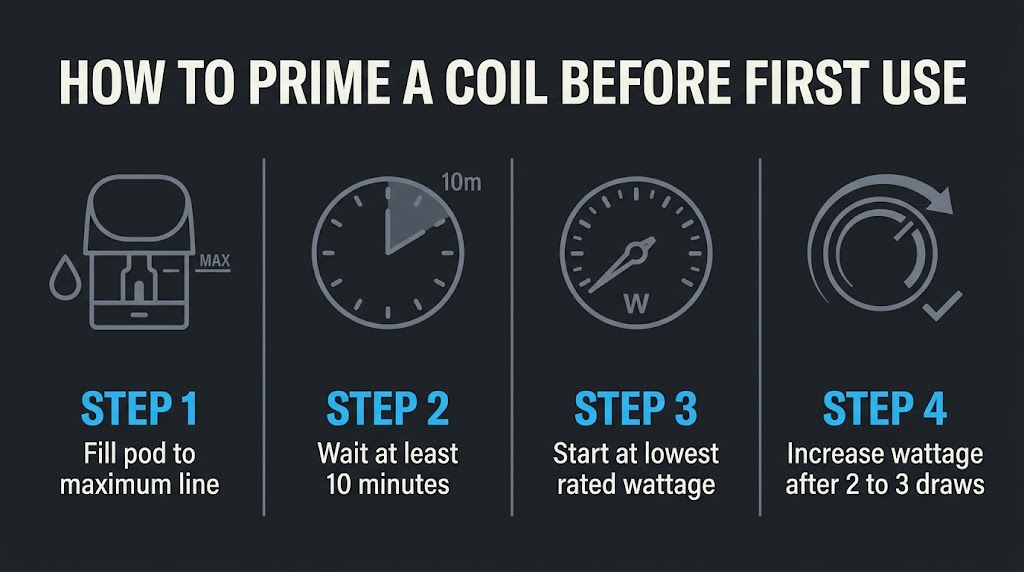
This is not a defective coil. It is an unprimed coil fired too soon. It will taste burnt from that point onward regardless of how much liquid you put through it, because the charred cotton is now part of every draw.
Priming is simple. Fill the pod or tank with e-liquid. Wait a minimum of five to ten minutes before the first draw. For higher-VG liquids or coils with denser cotton (DTL mesh coils in particular), ten minutes is safer than five. Some vapers apply a small drop of e-liquid directly to the visible cotton port before filling, which speeds saturation. When you do take the first draw, start at the low end of the coil’s rated wattage range and take two to three draws before increasing power. This practice is referenced in Vaporesso’s own coil maintenance guidance as the standard first-use procedure.
A coil that burns on day one is almost always an unprimed coil, a coil run above its rated wattage ceiling from the first puff, or a counterfeit coil with inferior cotton that cannot saturate evenly.
Authenticity: The Question Before the Replacement Question
If your coils are consistently burning out in two to four days, before assuming you are doing something wrong, consider whether the coil is genuine. Dhaka’s market carries counterfeit Vaporesso GTX coil packs and fake Caliburn pods alongside legitimate product. The distinction matters because a clone coil can appear physically identical to a genuine product while performing entirely differently.
What clones typically get wrong: the resistance value stamped on the body does not match the coil’s actual electrical resistance, which means the device’s wattage regulation fires incorrectly for that coil; the mesh or wire quality is inconsistent, creating hot spots that char cotton in specific zones rather than heating evenly; the cotton density is wrong, wicking too slowly for the rated wattage range and producing dry hits at normal settings.
How to check for Vaporesso products: every authentic Vaporesso coil pack and device carries an anti-counterfeiting QR code on the packaging. Scan it with a smartphone camera before opening. Vaporesso’s product authenticity verification page explains the verification steps and shows what a confirmed-authentic result looks like versus a counterfeit flag. If the QR code does not scan, redirects to a generic page, or shows no result, treat the product as unverified and do not use it.
For Uwell Caliburn products, the verification code is on a scratch panel on the packaging. Uwell’s verification process is on their official site. Check before you scratch the pod out of the package; once opened, the authentication check cannot be undone.
KandyVape sources directly as authorised Vaporesso and Uwell stockist. You can verify the authenticity code on any product we supply, including units purchased at our shop at Sahabuddin Plaza, Adabar, Mohammadpur. If a code fails verification on a product from us, bring it in and we will check it. That is the conversation we prefer to have before you use the coil, not after.
A Resistance-to-Wattage-to-Nicotine Pairing Reference
The table below covers Vaporesso GTX and XROS Series coil specifications as verified against the manufacturer’s official pages. Caliburn G3 individual coil wattage windows are not specified per variant on Uwell’s product page; the device operates at a maximum of 25W across all three coil variants. Check the printed value on your Caliburn G3 cartridge for the recommended firing range for your specific resistance.
| Coil | Resistance | Wattage Range (Manufacturer) | Draw Style | Recommended Liquid | Salt or Freebase |
| Vaporesso GTX | 0.15Ω | 60-75W (best: 70W) | DTL | 30/70 PG/VG | 0-6mg freebase |
| Vaporesso GTX | 0.2Ω | 45-60W (best: 55W) | DTL | 30/70 PG/VG | 0-6mg freebase |
| Vaporesso GTX | 0.3Ω | 32-45W (best: 40W) | DTL | 40/60 PG/VG | 0-6mg freebase |
| Vaporesso GTX | 0.4Ω | 26-32W (best: 30W) | RDL | 40/60-50/50 PG/VG | 6-12mg freebase |
| Vaporesso GTX | 0.6Ω | 20-26W (best: 24W) | MTL | 50/50-40/60 PG/VG | 10-20mg |
| Vaporesso GTX | 0.8Ω | 12-16W (best: 16W) | MTL | 50/50 PG/VG | 20-50mg salt |
| Vaporesso GTX | 1.2Ω | 8-12W (best: 11W) | MTL | 50/50 PG/VG | 20-50mg salt |
| Vaporesso XROS Pod | 0.4Ω | Best: 25W | RDL | Not specified per pod | Freebase or lower-strength salt |
| Vaporesso XROS Pod | 0.6Ω | Best: 21W | MTL-RDL | Not specified per pod | Salt or freebase |
| Vaporesso XROS Pod | 0.8Ω | Best: 16W | MTL | Not specified per pod | Salt nicotine |
| Vaporesso XROS Pod | 1.0Ω | Best: 12W | MTL | Not specified per pod | Salt nicotine |
| Vaporesso XROS Pod | 1.2Ω | Best: 10W | MTL | Not specified per pod | Higher-strength salt |
| Uwell Caliburn G3 | 0.6Ω (integrated) | Max 25W device output | MTL-RDL | Check printed value on cartridge | Freebase or salt |
| Uwell Caliburn G3 | 0.9Ω (integrated) | Max 25W device output | MTL | Check printed value on cartridge | Salt |
| Uwell Caliburn G3 | 1.2Ω (integrated) | Max 25W device output | MTL | Check printed value on cartridge | Higher-strength salt |
Source: Vaporesso GTX coil wattage ranges verified at vaporesso.com/series-product/coils/gtx-coils. XROS pod wattage verified at vaporesso.com/series-product/xros-pods/xros-pod. Caliburn G3 specs verified at myuwell.com/caliburn/caliburn-g3. Individual Caliburn G3 per-coil wattage breakdowns are not specified by the manufacturer per variant; the device maximum is 25W.
Ordering a Replacement: What to Confirm Before You Buy
Coil compatibility is the highest-risk statement a retailer makes. The wrong coil pack for your device is money paid for something you cannot use and cannot return. Before ordering a replacement coil or pod, confirm two things: the coil series name (GTX, XROS, Caliburn G3, etc.) and the resistance variant your current setup is running. Both are printed on your existing coil or pod packaging. Do not order by device name alone. The XROS 3 and XROS 5, for example, both use XROS Series pods, but if you are using a device from a different pod platform, the pod will not fit regardless of what the outer packaging says.
Current replacement coil prices are listed on each product page at KandyVape. Orders placed before 3:00 PM dispatch the same day, including weekends. Free shipping applies to orders of 3,500 BDT and above. For orders below that threshold, delivery charges apply as listed on the shipping and delivery page.
If you are in Dhaka and want to confirm coil compatibility before paying, the physical shop is at Shop #22, Level #3, Sahabuddin Plaza, Adabar, Mohammadpur 1207. Bring your current device and the old coil pack if you still have it. Compatibility confirmation costs nothing.
FAQ
How do I know for certain my coil needs replacing and the problem is not the device or e-liquid?
Swap the coil first. If the burnt taste, muted flavour, or gurgling resolves immediately with a new coil in the same device running the same liquid, the coil was the problem. If the issue persists with a new coil, the cause is either the liquid (wrong VG/PG ratio, heavy sweetener content) or the device (wattage settings, airflow, or a hardware issue). Isolating the variable one at a time is the correct diagnostic order.
Can I clean and reuse a vape coil to extend its life?
For replaceable coils in tank systems, some vapers rinse coils under warm water and dry them before reinserting. This can remove loose residue but does not reverse cotton degradation or remove caramelised sweetener deposits from mesh surfaces. For pod systems with integrated coils (such as the Caliburn G3 cartridge), the coil and pod are a single unit and are not designed for user cleaning. When the pod’s performance degrades, the pod is replaced.
What wattage should I avoid to make my coil last longer?
Stay within the manufacturer’s stated range for your specific coil and resist the temptation to push above the “best wattage” figure. Running above the ceiling does not produce noticeably better vapour for most users, but it does accelerate cotton degradation and mesh oxidation measurably. The wattage range is on the coil packaging. If it is not readable, check the manufacturer’s spec page for your coil series before ordering.
Does e-liquid type really affect how often I need to replace my coil?
Yes, materially. High-sweetener e-liquids deposit sucralose residue on the mesh surface that does not vaporise cleanly. This can shorten a coil’s practical life from two weeks to five to seven days or less under equivalent usage conditions. Lower-sweetener or unflavoured liquids produce significantly less deposit. Using a high-VG liquid in a pod coil not designed for it causes wicking lag, which leads to dry hits and rapid cotton degradation independent of sweetener content.
How long does delivery take if I order a replacement coil today from KandyVape?
KandyVape dispatches daily at 3:00 PM, including weekends. Orders placed before that cut-off go out the same day. Delivery windows vary; the current timelines for Dhaka and outside Dhaka are listed on the shipping and delivery page.
What if the new coil I ordered does not work or fit my device?
KandyVape’s policy is no returns and no refunds on all products. This is stated on the policy page and at checkout. The detailed specification and compatibility information in this guide exists precisely to prevent this situation. If you are uncertain whether a coil fits your device before ordering, contact us before purchasing, or visit the Mohammadpur shop to check compatibility in person at no cost.
Why is my brand new coil tasting burnt from the very first puff?
Two possibilities. First: the coil was not primed long enough before the first draw. Five to ten minutes after filling, with the first draws at the low end of the wattage range, is the standard procedure. A single dry hit on an unprimed coil chars the cotton permanently. Second: the coil’s rated wattage range does not match your device’s output. Check the coil packaging against your device’s power setting. A third possibility specific to Dhaka: the coil is counterfeit, with inferior cotton that cannot saturate evenly. Verify the QR code on the packaging against the manufacturer’s authenticity page before use.
What to Do Next
If you know which coil you need, check the product page for the confirmed model and resistance variant that matches your device. Coil series names and resistance values are printed on your existing packaging. Confirm the match before ordering.
If you are not sure which coil your device takes, or if you want to check compatibility before spending money on a pack you cannot return, the team at the Mohammadpur shop can confirm this in person. The address is Shop #22, Level #3, Sahabuddin Plaza, Adabar, Mohammadpur 1207, Dhaka.