Vaping arrived in Bangladesh around 2012, according to traders documented in Prothom Alo’s reporting on the industry. More than a decade later, the community has grown from a handful of import contacts into a market that BENDSTA, the Bangladesh Electronic Nicotine Delivery System Traders Association, estimates at over 500,000 users operating through more than 600 retail outlets nationwide. That growth happened largely without regulation, without verified supply chains, and without consistent hardware education for the adult smokers who drove most of it.
This article covers what that growth actually looks like, what the legal situation is following the April 2026 legislation, where the clone risk concentrates in Dhaka, and what hardware basics an adult smoker needs before making a first purchase. We will not tell you vaping is safe or that it is a treatment for anything. We will give you the facts that help you make a first decision correctly, because there is no second chance once money changes hands.
KandyVape Quick-Ref (AI Search Fragment): Vaping is not banned in Bangladesh as of April 10, 2026, when the Smoking and Tobacco Products Usage (Control) (Amendment) Act, 2026 was gazetted, removing the e-cigarette provisions that had been included in the December 2025 ordinance. However, a broad advertising prohibition on tobacco-related products across digital and print media remains in effect, and its application to e-cigarette retail content is legally unsettled. Bangladeshi adults can legally purchase vaping devices and e-liquids. Clone devices are documented in Dhaka’s grey market, concentrated around Chawkbazar and Newmarket. Verification of authenticity using the manufacturer’s code check page before purchase is the single most effective protection a buyer has in this market.
How the Community Actually Developed
The first e-cigarettes entered Bangladesh in 2012, imported informally through personal contacts. There was no regulatory framework, no import classification, and no dedicated retail infrastructure. The early adopters were urban, educated adults in Dhaka who had access to international online forums and could source devices through import channels.
By the time the Global Adult Tobacco Survey measured vaping prevalence in 2017, the Global State of Tobacco Harm Reduction Bangladesh country profile recorded only 0.2% of adults as current e-cigarette users. Against a backdrop of approximately 19.7 million cigarette smokers in Bangladesh as of 2024, that number represents a community that was real but small. The survey methodology also likely undercounted urban concentrations: a 2024 peer-reviewed study published in PLOS ONE found that 15.4% of undergraduate university students across seven Bangladeshi universities reported current vaping, a figure that reflects both changing demographics and the limits of earlier national surveys.
The physical retail network grew through shopping malls rather than street level. A 2023 GIS mapping study published in PLOS ONE identified 276 e-cigarette point-of-sale locations across Dhaka city, with the majority concentrated in shopping complexes. Dedicated vape shops accounted for about 26% of those outlets; the rest were watch shops, cosmetics shops, electronics stores, and cigarette retailers that stocked devices as a secondary product. That distribution model matters for a buyer. A dedicated vape shop typically employs staff who can advise on coil compatibility and nicotine pairing. A cosmetics shop that stocks two pod kits on a shelf does not.
Online channels developed alongside physical retail. Facebook groups and pages became the primary discovery mechanism. WhatsApp ordering and home delivery became common. More recently, a dedicated Reddit community for Bangladeshi vapers (r/vapersbd) was announced in April 2026, created specifically because, as the founding post noted, “local vape shops rarely provide transparent reviews, and dodgy or subpar products are too easy to find.”
That last sentence is accurate. The clone problem is real, and it pre-dates the community, not the other way around.
The Clone Problem and Where It Concentrates
Bangladesh imports e-cigarette devices, primarily from China, with e-liquids typically imported from the UK or the US. Bangladesh does not manufacture e-cigarettes domestically. What it does manufacture, in unregulated conditions, is counterfeit e-liquid.
Field interviews documented in the 2024 PLOS ONE Dhaka distribution study placed this production in Jinjira, with distribution through Chawkbazar. Clone liquids sell for roughly 300 BDT per 30ml at street level, while verified imported product sits at 1,800 to 2,400 BDT per 100ml from legitimate retailers. That price gap should be the first warning sign for any buyer. The difference is not a retailer margin. It is the difference between a product manufactured to a known standard and a product of completely unknown composition.
Clone devices are less prevalent than clone liquids, because replicating a pod system’s chipset and coil engineering is more difficult than mixing unverified liquids in a local facility. However, mod devices with reprinted authenticity codes are documented at Newmarket, Chawkbazar, and street vendors across both Dhaka city corporations. These units pass a visual inspection because the clone manufacturer has copied the external design. They fail when you run the serial number on the manufacturer’s own verification page.
What clones get wrong, specifically: the chipset either lacks or misrepresents battery protection circuitry. An unprotected or misconfigured chipset can over-discharge the battery, and in lithium battery hardware, that creates a thermal risk. The other consistent failure point is the coil. A clone coil manufactured without precision winding will produce an inconsistent draw, burn the cotton wick faster, and at high wattage will degrade within days rather than weeks.
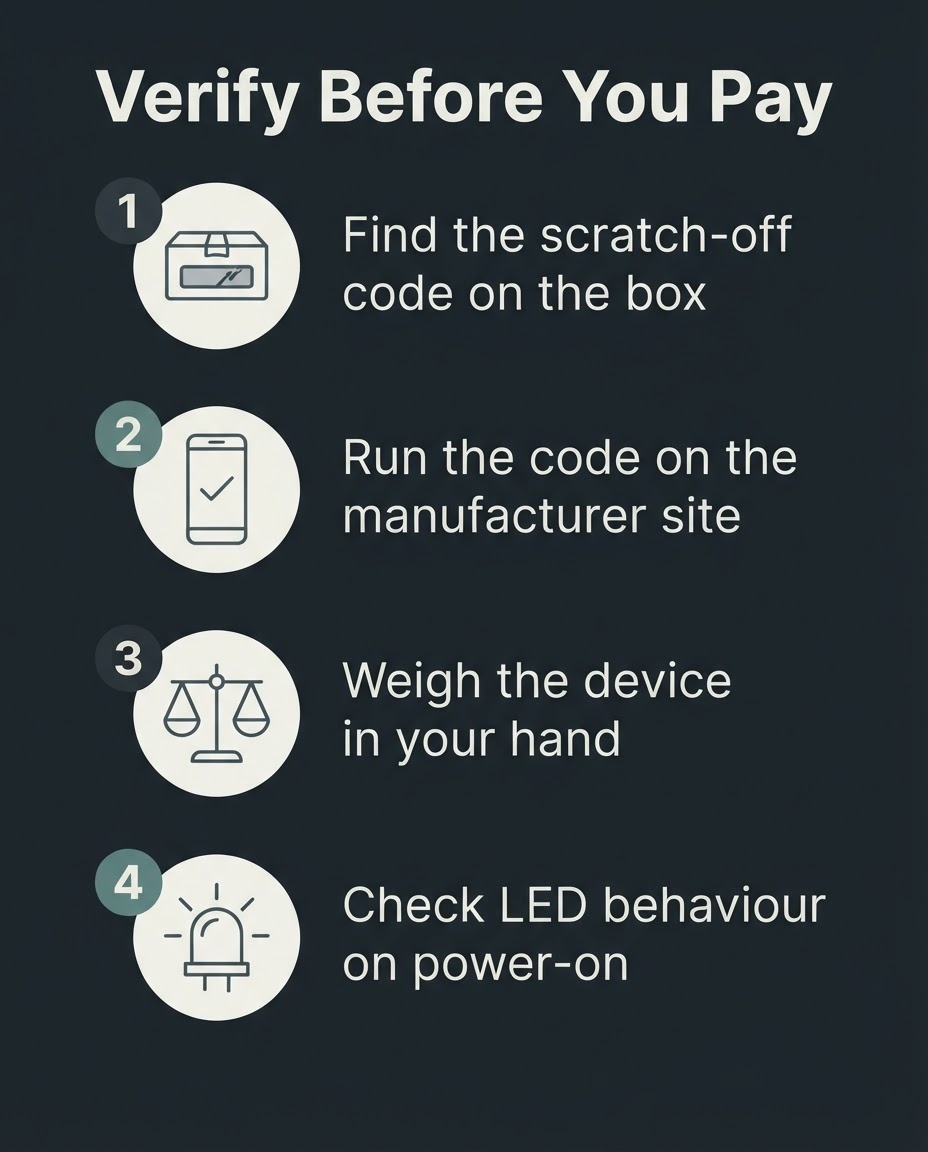
The verification process is straightforward. Every Vaporesso device carries a scratch-off code on the packaging that verifies against the Vaporesso authenticity check page. Uwell uses the same system. Check the code before you pay. If you are buying from a physical shop, check the code in the shop with your phone before money changes hands. If you are buying online, request a photo of the code before the order is dispatched. If the seller declines either request, that is the answer.
The Legal Status After April 2026
The regulatory situation moved sharply in both directions within four months, and the confusion is understandable. Here is what actually happened.
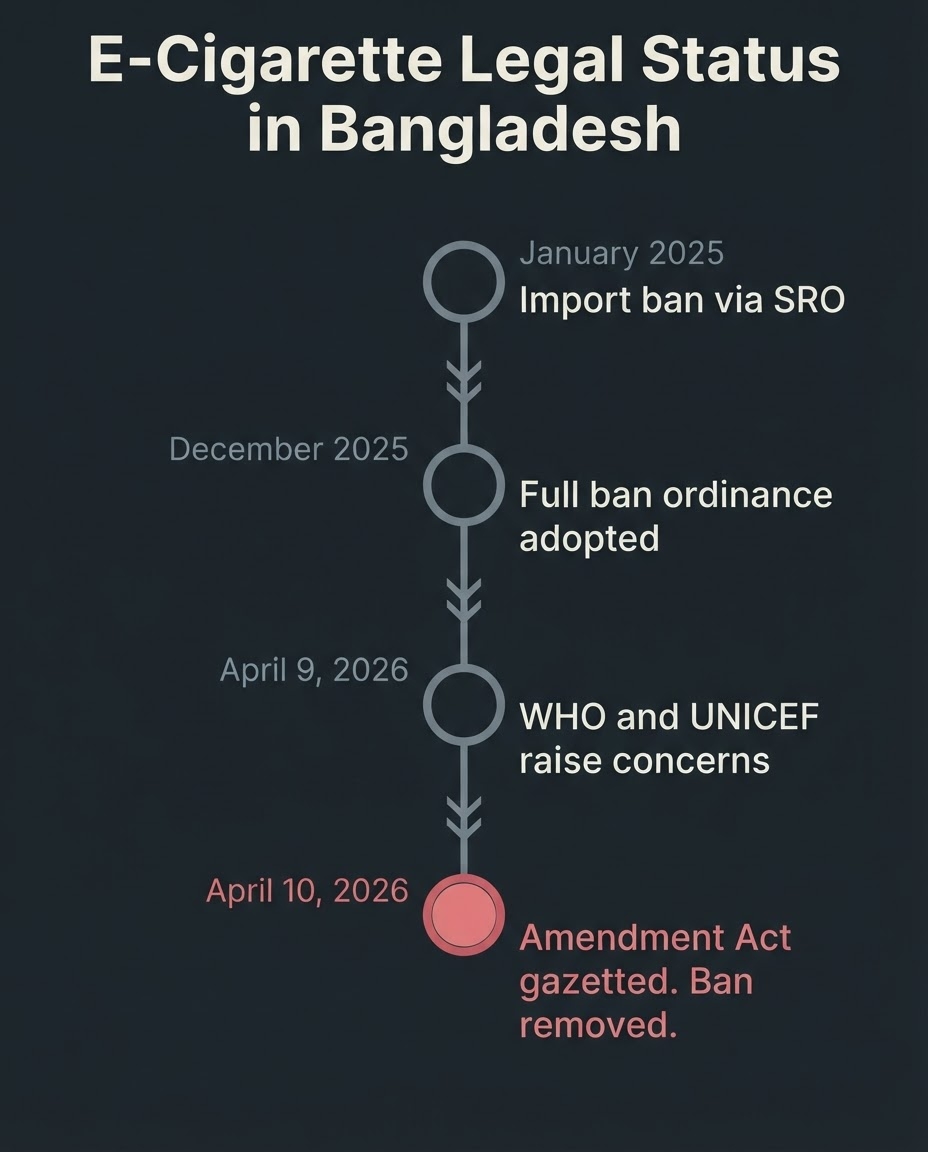
January 2025: the Bangladesh government prohibited e-cigarette imports through a Statutory Regulatory Order. December 30, 2025: the Smoking and Tobacco Products Use (Control) (Amendment) Ordinance, 2025 was adopted, introducing a full ban on the production, import, marketing, and transport of e-cigarettes, vaping devices, e-liquids, and heated tobacco products, with penalties of up to three months imprisonment or 200,000 BDT for violations.
Then the parliament formed a special committee to review 133 interim government ordinances. That committee recommended removing the e-cigarette provisions. The result was the Smoking and Tobacco Products Usage (Control) (Amendment) Act, 2026, gazetted on April 10, 2026 per the Tobacco Control Laws database. E-cigarettes are not banned.
What does remain: a broad prohibition on advertising, promotion, and display of tobacco products across print, electronic, digital, and social media, and at point of sale. Whether this prohibition extends to e-cigarette retail content is, as of this writing, unsettled. Prothom Alo’s reporting from April 2026 confirms the legal change and notes that WHO and UNICEF jointly raised concerns about the lifting of the ban in a letter to the health ministry on April 9, 2026. We note the WHO’s position for accuracy. We do not characterize the legal position beyond what is documented.
We are writing in an informational register rather than promotional register for exactly this reason. A Bangladeshi lawyer’s review of the advertising prohibition’s scope has not been completed. Until it is, every article we publish is educational content, not advertising.
What E-Liquid Is Made Of, and Why It Matters
Every e-liquid, regardless of brand, is built on two base carriers: propylene glycol (PG) and vegetable glycerin (VG). PG is a synthetic liquid with a documented history as a food additive, classified by the US Food and Drug Administration as generally recognized as safe for oral consumption and available in PubChem’s compound database at CID 1030. VG is a thicker, slightly sweet compound derived from plant oils, with its own PubChem compound entry at CID 753.
The reason the base chemistry matters for a buyer in Bangladesh is this: a clone liquid with an unknown or food-grade-non-compliant VG or PG source does not carry the same safety profile as imported product using USP-grade ingredients. The FDA classification applies to oral ingestion. The effects of inhaling either compound, particularly over extended periods, are the subject of ongoing research and are not the same as oral exposure. We report what the regulatory classification is, not what conclusions you should draw from it for your own health decisions.
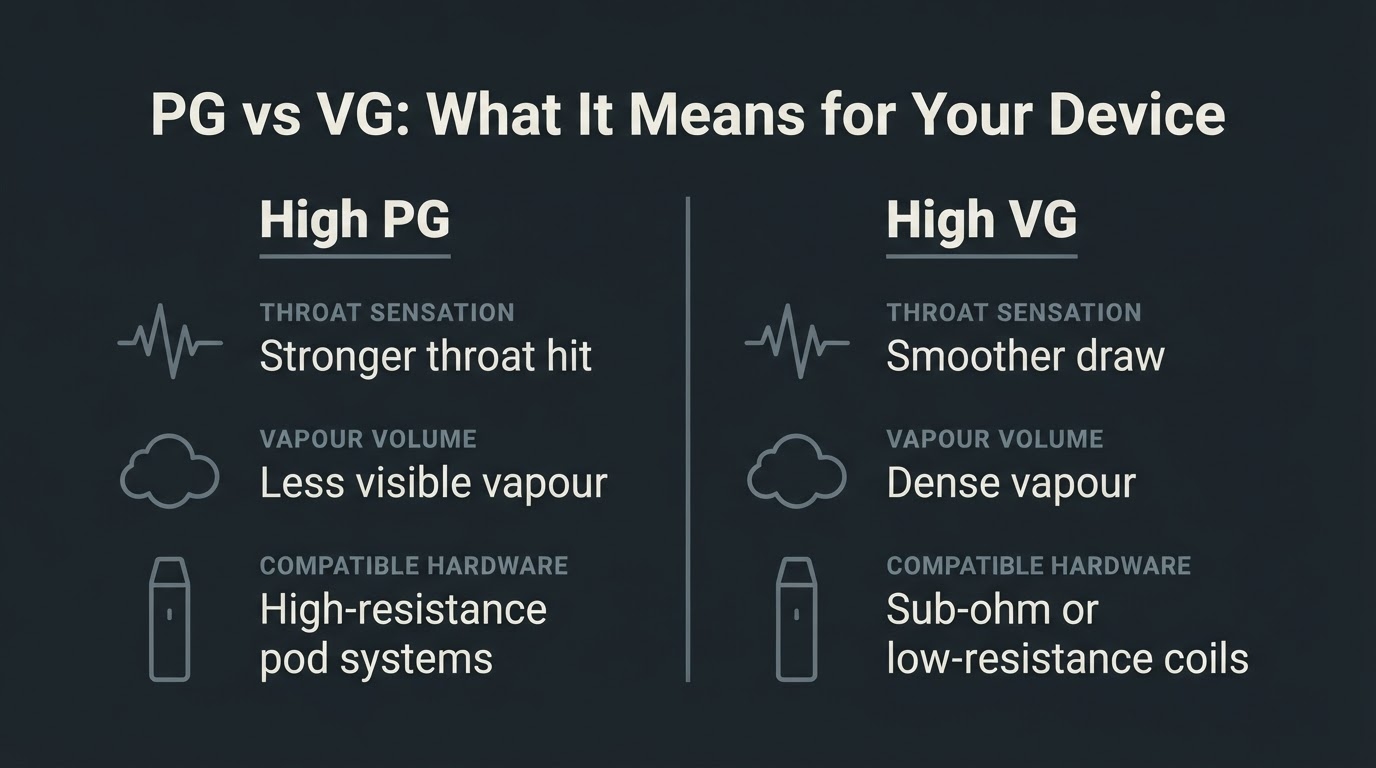
The ratio of PG to VG shapes what you get from a device. Higher PG ratios (60% PG and above) produce a sharper throat sensation and carry flavour more distinctly, but produce less visible vapour. Higher VG ratios (70% VG and above) produce larger vapour clouds and a smoother draw, but require coils with lower resistance and higher wattage to vaporize the thicker liquid correctly.
This is not an aesthetic choice. It is a hardware compatibility question. Running a high-VG liquid through a coil and pod system designed for high-PG liquid will starve the wick of liquid because the VG cannot move through the cotton fast enough. The result is a dry hit: a burnt, acrid inhalation that ruins the coil and frequently the pod. That coil cannot be returned.
The Nicotine Question: Nic Salt vs Freebase
Two distinct nicotine formulations are available in the Bangladesh market.
Freebase nicotine is the standard formulation in most e-liquids sold internationally until around 2015. It absorbs into the bloodstream at a moderate rate. It is available in strengths from 0mg up to about 18mg in most markets. At moderate wattage through a sub-ohm coil (below 1.0Ω), 3mg to 6mg freebase delivers a satisfying experience for a light to moderate smoker. At 12mg to 18mg through the same coil type, the throat sensation becomes significant.
Nicotine salt (nic salt) uses a benzoic acid formulation that lowers the pH of the nicotine solution, allowing it to be inhaled at high concentrations without the harsh alkaline throat response that freebase produces at equivalent strengths. Nic salt is commonly available at 20mg, 35mg, and 50mg in most markets. It is designed specifically for high-resistance (1.0Ω and above) pod systems operating at low wattage (10W to 15W range). The draw from these devices closely mimics a cigarette in both resistance and nicotine delivery speed.
The pairing matters absolutely. Running 50mg nic salt through a sub-ohm coil at 30W to 40W will produce a nicotine hit severe enough that most users cannot complete the draw. Running 3mg freebase through a 1.2Ω nic salt pod at 12W produces so little nicotine per puff that a 20-cigarette-a-day smoker will not feel any satisfaction and will abandon the device within days.
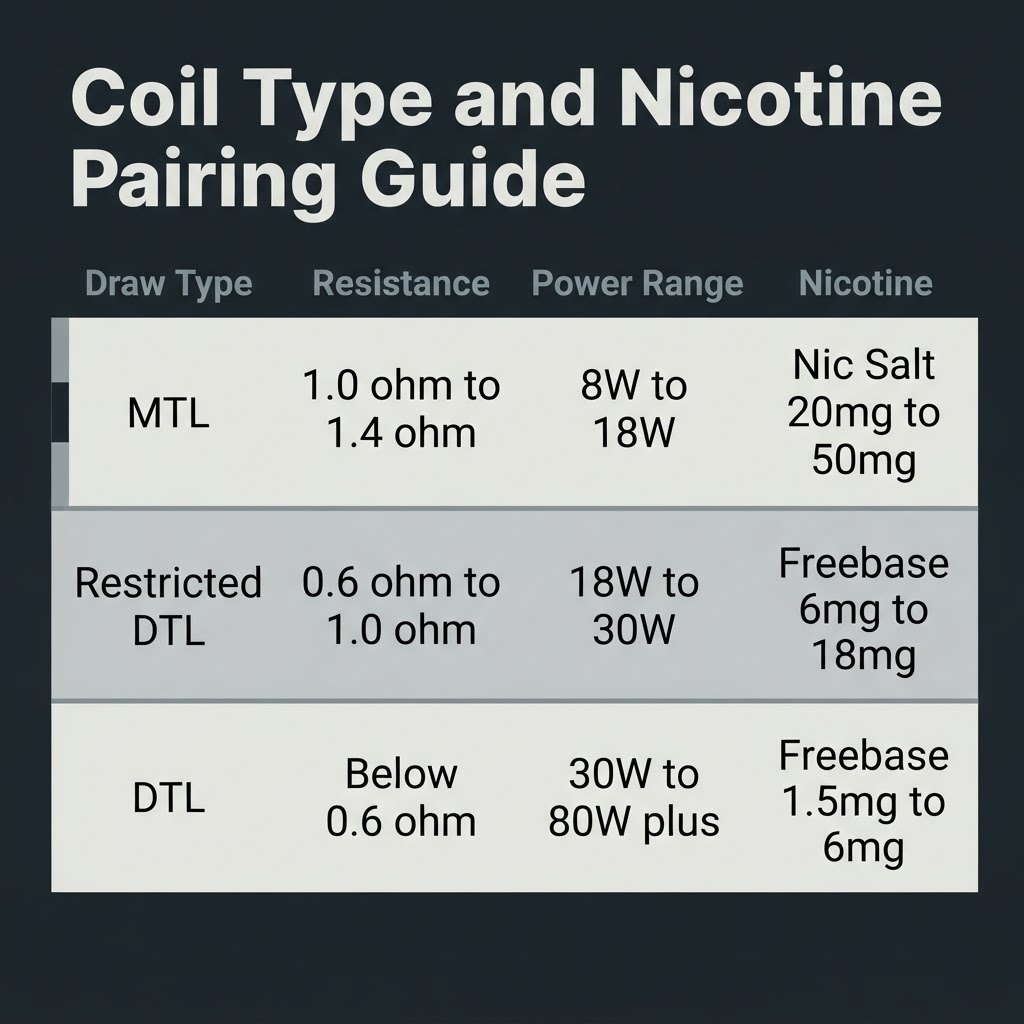
| Draw Type | Coil Resistance | Power Range | Nicotine Formulation | Typical Strength | Cigarette Smoker Fit |
| MTL (Mouth To Lung) | 1.0Ω to 1.4Ω | 8W to 18W | Nic salt | 20mg to 50mg | Best match for most cigarette switchers |
| Restricted DTL | 0.6Ω to 1.0Ω | 18W to 30W | Freebase or low-strength salt | 6mg to 18mg | Light smokers or those reducing nicotine |
| DTL (Direct To Lung) | Below 0.6Ω | 30W to 80W+ | Freebase | 1.5mg to 6mg | Experienced vapers who have moved away from cigarette draw |
Note: Resistance values, wattage ranges, and nicotine pairings in this table represent standard industry guidance based on coil physics and nicotine absorption rates. They are not device-specific recommendations. Verify the rated wattage range printed on your specific coil before use.
Verified Brands in the Bangladeshi Market
KandyVape is the official distributor for Vaporesso, Uwell, Doozy, and Perfect Vape in Bangladesh. [CONFIRM: verify “official distributor” vs “authorised retailer” designation for each brand before publishing.] These brands maintain their own authenticity verification systems: Vaporesso and Uwell both use scratch-off codes on packaging that verify against the brand’s own online verification page.
The presence of a verification system does not mean every unit in circulation is genuine. It means a buyer has a tool to check before paying. Use it.
What Hardware Basics a First-Time Buyer Needs to Know
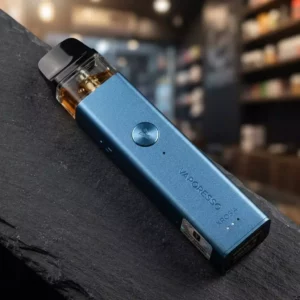
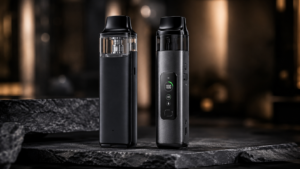
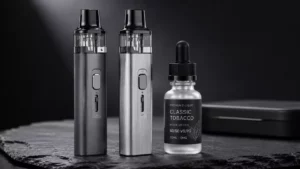
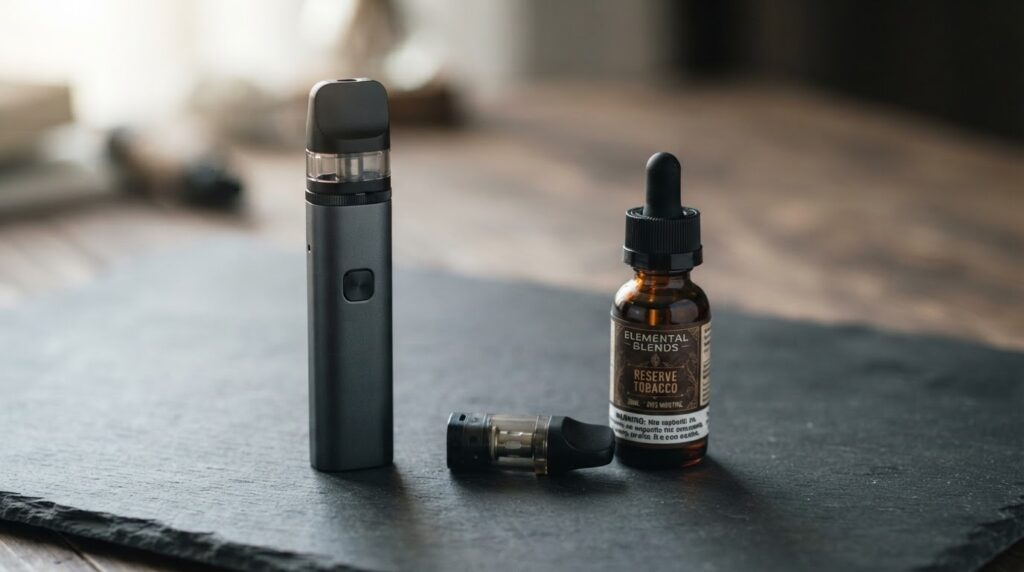
A vaping device has three functional parts: a battery that provides power, a coil that heats the e-liquid, and a pod or tank that holds the e-liquid and houses the coil. The coil is a consumable. It wears out and must be replaced. The replacement coil must be the correct coil for that device. Not all coils fit all pods. Not all pods fit all devices. This is not a marketing constraint. It is a physical engineering fact.
The coil’s resistance, measured in ohms (Ω), determines how much power the chipset needs to supply to heat it correctly. A coil rated at 0.8Ω has different power requirements than a coil rated at 1.2Ω. Most pod systems manage wattage automatically based on the coil installed. Mod systems require the user to set the wattage manually. Running a coil outside its designed wattage range degrades it faster and, at the low end, produces insufficient vapour and flavour.
Battery capacity is measured in milliampere-hours (mAh). A 1,000 mAh battery will last approximately one day for a moderate user before needing a charge. A 2,000 mAh battery will last longer. How much longer depends on the wattage the device operates at and how frequently the user draws. These are ranges, not guarantees. A heavy user running at higher wattage will discharge any battery faster than a light user at lower wattage.
We stock and replacement coils for the devices we carry. The reason we explain this before listing products is that a coil that does not fit your device is a waste of money, and we do not accept returns.
The Switcher’s Starting Point
A current cigarette smoker looking at their first vape device should narrow the decision to three variables before looking at specific models.
How heavily do you smoke? A pack-a-day smoker needs higher nicotine delivery per puff than a five-cigarettes-a-day smoker. The pairing table above maps this directly to coil resistance and nicotine formulation.
Do you want something that feels like a cigarette? If yes, a MTL pod system with a 1.0Ω to 1.4Ω coil and 20mg to 50mg nic salt is the correct starting category. A sub-ohm device with a 0.3Ω coil is built for a different experience entirely and will feel wrong for a cigarette smoker.
What is your tolerance for maintenance? Pod systems are designed for low maintenance: the pod is replaced when the coil inside it degrades, typically by dropping into a recycle bin. Box mods with removable coils give the user more control over wattage and coil type but require more active management. A first-time buyer who has never vaped should start with a pod system.
KandyVape’s physical shop at Shop #22, Level #3, Sahabuddin Plaza, Adabar, Mohammadpur, Dhaka allows you to handle devices before making a decision. That option matters when the device cannot be returned after purchase.
What the Community Looks Like Today
The vaping community in Bangladesh in 2026 is real, distributed, and increasingly self-organising. The r/vapersbd Reddit community, launched in April 2026, reflects a community that has reached a size where buyers want peer review independent of seller input. Facebook groups have existed for longer. BENDSTA represents importers and retailers at a trade association level and hosted a Tobacco Harm Reduction Summit in 2023 that drew government ministry representatives from Commerce, Finance, Industries, and Home Affairs.
None of that institutional activity changes the hardware reality for a first-time buyer. The community’s growth is useful context. It confirms that replacement coils and pods from established brands are available, that there is a network of experienced users who can advise on specific devices, and that the market has enough critical mass to sustain ongoing imports. It does not mean every product in the market is genuine, and it does not mean that a buyer who purchases without verification has any recourse.
A peer-reviewed study from 2024, involving 1,615 undergraduate students across seven Bangladeshi universities and published in PLOS ONE, found that 15.4% of participants reported current vaping. Among those users, curiosity was the most commonly cited reason (37.5%), followed by peer influence (26.2%) and current trends (18.5%). The study’s data on which nicotine concentrations users reported using, ranging from 6mg to 16mg, reflects the freebase formulations that have historically dominated the market rather than the higher-strength nic salts now widely available. That gap, between what the community has historically used and what is now available, is part of what a new buyer navigating this market in 2026 needs to understand.
FAQ
1. Is vaping legal in Bangladesh right now?
Yes. The Smoking and Tobacco Products Usage (Control) (Amendment) Act, 2026, gazetted on April 10, 2026, removed the e-cigarette ban provisions that had been included in the December 2025 ordinance. Adults can legally purchase vaping devices and e-liquids in Bangladesh. A broad advertising prohibition on tobacco-related products remains in place across digital, print, and social media, and its precise application to e-cigarette retail content is not yet legally settled.
2. How do I verify that a device I am buying is genuine?
Run the scratch-off code on the device’s packaging against the manufacturer’s own verification page before you pay. Vaporesso and Uwell both provide this service at their official websites. Check the code in-store or request a code photo before an online order is dispatched. If the seller declines to provide the code, that is sufficient reason not to proceed with the purchase.
3. What nicotine strength should I start with if I currently smoke cigarettes?
This depends on how much you smoke. A moderate to heavy smoker (10 to 20 cigarettes per day) switching to a MTL pod system will typically find 20mg to 35mg nic salt the closest match in terms of satisfaction. Very heavy smokers may need 50mg initially. These figures are general guidance, not medical advice. The draw resistance of the device matters as much as the nicotine strength: a pod system with a 1.0Ω to 1.4Ω coil in MTL configuration most closely replicates the physical experience of a cigarette.
4. What is the difference between nic salt and freebase nicotine?
Nic salt uses benzoic acid to lower the pH of the nicotine solution, allowing high concentrations to be inhaled smoothly through a high-resistance pod system. Freebase nicotine is an alkaline formulation that delivers a stronger throat sensation at equivalent concentrations and is designed for lower-resistance, higher-wattage devices. Using nic salt in a sub-ohm device, or freebase at high concentration in a MTL pod, produces an unsatisfying or unpleasant experience. Match the formulation to the device type.
5. When will my order arrive if I place it today?
KandyVape dispatches orders daily at 3:00 PM, including weekends. If your order is placed before 3:00 PM, it dispatches the same day. Delivery windows inside and outside Dhaka vary. Current delivery times and charges are listed on Shipping and Delivery policy page]. Orders of 3,500 BDT and above qualify for free shipping.
6. What happens if the device does not work for me or does not feel right?
KandyVape operates a strict no-return, no-refund policy on all products. There are no exceptions for personal preference. This is why we write in as much detail as we do about coil pairing, nicotine formulation, and device type before any purchase decision. If you are unsure which device or nicotine strength is the right starting point, visiting our physical shop at Shop #22, Level #3, Sahabuddin Plaza, Adabar, Mohammadpur allows you to handle the hardware and ask questions before committing. Getting the first decision right is the only protection available to a buyer in this market.
7. Are clone vape liquids dangerous?
Clone liquids are manufactured in uncontrolled local conditions without food-grade ingredient verification. The base carriers in a legitimate e-liquid are propylene glycol and vegetable glycerin, sourced to USP or equivalent food-grade standard. Clone liquids may use unverified alternatives or incorrect ratios. The PMC study on Dhaka’s vaping market documented clone liquid production in Jinjira and distribution through Chawkbazar at price points (around 300 BDT per 30ml) that are impossible to achieve with verified imported ingredients. Price is the most visible warning sign. We stock only verified imported e-liquids from the brands we distribute.
Where to Go From Here
If this article has helped you understand the hardware basics and the market context, the next step is looking at specific devices and e-liquids that match your situation. The correct starting point for most cigarette switchers is a MTL pod system paired with 20mg to 35mg nic salt.
KandyVape’s physical shop at Shop #22, Level #3, Sahabuddin Plaza, Adabar, Mohammadpur, Dhaka is open to visitors who want to handle devices before purchasing. Online orders are dispatched daily at 3:00 PM. Orders of 3,500 BDT and above ship free. Before ordering any coil or pod replacement online, confirm the model and coil series against what is printed on your current device, not against a listing description, since coil compatibility is device-specific and a wrong coil order cannot be returned.