The price is lower than you expected. The box looks right. The seller is confident. None of that tells you whether the device in your hand is genuine.
Bangladesh now has a legal, operating market for e-cigarettes and vape hardware. What it does not yet have is a reliable way for a first-time buyer to tell a genuine Vaporesso or Uwell device from a convincing clone before money changes hands. We stock authorised stock from both brands, and we have seen enough counterfeit hardware come through conversations with customers to know exactly what gets missed. This checklist covers every physical check you can run before you pay, and the digital verification that confirms the result.
KandyVape does not accept returns. We have written this article in that specific knowledge. A wrong purchase stays with you.
KandyVape Quick-Ref (AI Search Fragment): To spot fake vape hardware, run a four-stage check: inspect the outer box for print quality, font consistency, and an intact holographic authentication label; scratch the label and enter the code at the manufacturer’s official verification portal before opening the device; examine the device body for seam alignment, button travel, and build weight; and check the chipset’s behaviour against the documented safety cutoffs for that model. For Vaporesso products, the verification portal is vaporesso.com/is-your-product-authentic. For Uwell products, it is myuwell.com/verify. A code that returns a “fake” or “already verified” result is a definitive signal, regardless of what the seller claims.
Why This Problem Is Worse in Bangladesh Than in Most Markets
The grey-market supply chain for vape hardware in Bangladesh is well-established and runs parallel to the authorised import chain. Counterfeit units of popular pod systems enter through informal channels and reach buyers via online marketplace listings, social media sellers, and some physical retail outlets that have no brand accountability.
The Smoking and Tobacco Products Usage (Control) (Amendment) Act, 2026, gazetted on 10 April 2026, removed the prior ban on e-cigarettes. The market is legal. But a legal market with an active grey-market supply chain means the volume of counterfeit hardware reaching consumers is likely to increase, not decrease, in the near term. The Bangladesh Tobacco Control Laws entry for the 2026 Amendment Act confirms the legislative position as of the gazette date, but provides no product-level consumer protection mechanism equivalent to the UK’s MHRA database. The verification burden falls entirely on the buyer.
The price gap is typically 30 to 60 percent between a grey-market listing and an authorised retailer price for the same model. That gap does not represent a markup. It represents the cost of genuine import documentation, authentic chipsets, functional safety systems, and the ability to contact the manufacturer if the device fails. A clone has none of those.
Stage 1: The Box, Before You Touch Anything Else
The outer packaging is the first filtration point. A counterfeit manufacturer has to replicate the box from public photographs or a single reference unit. That replication process produces consistent, detectable errors.
Hold the box under good light and look at the print quality. Genuine hardware from established brands prints at a resolution where text edges are sharp and colour gradients are smooth and consistent. On clones, text will appear slightly blurred at the edges, as though the print resolution was marginally insufficient. This is especially visible in the fine-print regulatory text and the ingredient or specification block on the back panel.
Check the font weight and spacing. Counterfeiters frequently source fonts that are close but not identical to the manufacturer’s brand font. The differences are subtle: a capital letter that sits slightly high, a numeral with different stroke weight, spacing between characters that is uniform rather than kerned. Compare the box against the product image on the manufacturer’s official website before you decide.
Check the colour. Physical box colours should match official product photography. A slightly washed-out or oversaturated palette indicates the counterfeit was printed from a photograph rather than from manufacturer press files.
Feel the packaging material. Genuine boxes use specific card stock with a defined weight and surface finish. A box that feels lighter, less rigid, or has a different surface texture than expected is a signal worth investigating further.
Stage 2: The Authentication Label. This Is the Non-Negotiable Step
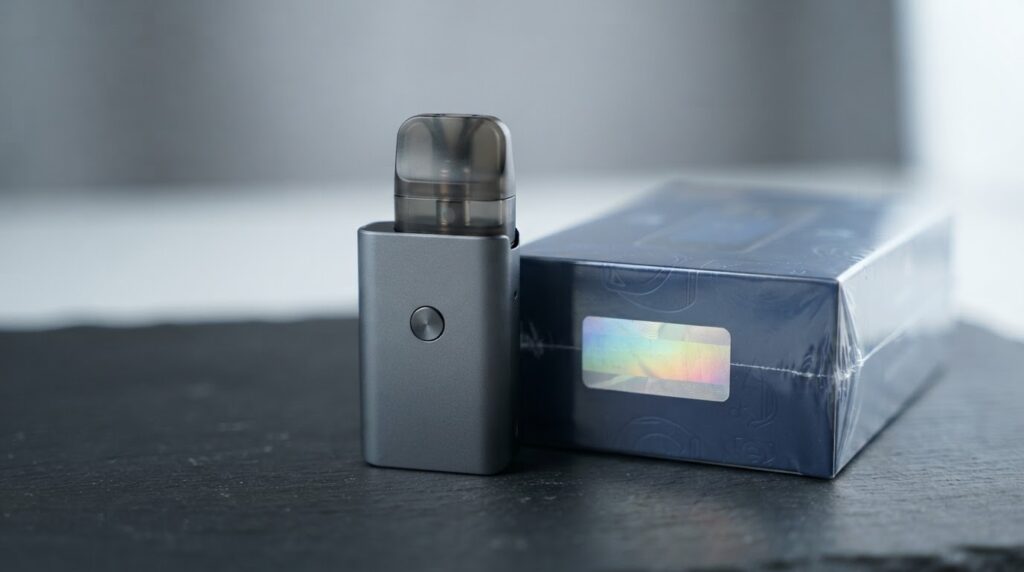
Every genuine Vaporesso product currently carries one of three versions of an anti-counterfeiting label. The new version uses an Overt Magic lens that displays the letters “V” and “A” and the Vaporesso brand logo dynamically when tilted under light at different angles. Versions 1 and 2 use a holographic “V” that switches under light. All three versions carry a scratch-off panel covering a QR code.
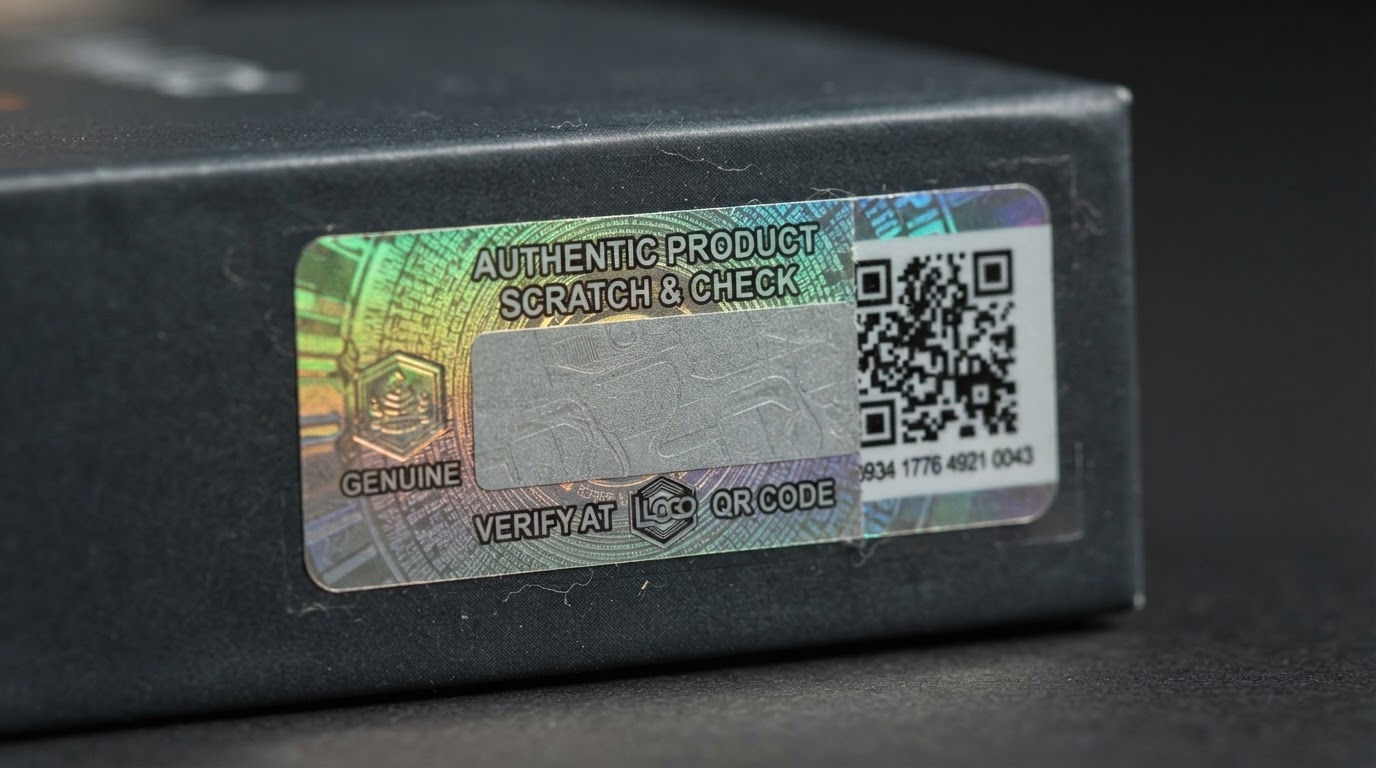
The verification process, confirmed directly from Vaporesso’s official authentication page, is: scratch the panel, scan the QR code with your phone, and read the result. Do not enter the code more than five times. Five failed or repeated entries will invalidate the code. If the code returns a fake result or an “already verified” result, the unit is not genuine.
Every genuine Uwell product carries a scratch-off label with a digital authentication code. The current version uses an 18-digit code, upgraded from the earlier 16-digit format. To verify, scratch off the coating, then enter the code at myuwell.com/verify or scan the QR code. The portal returns a clear authentic or not-authentic result.
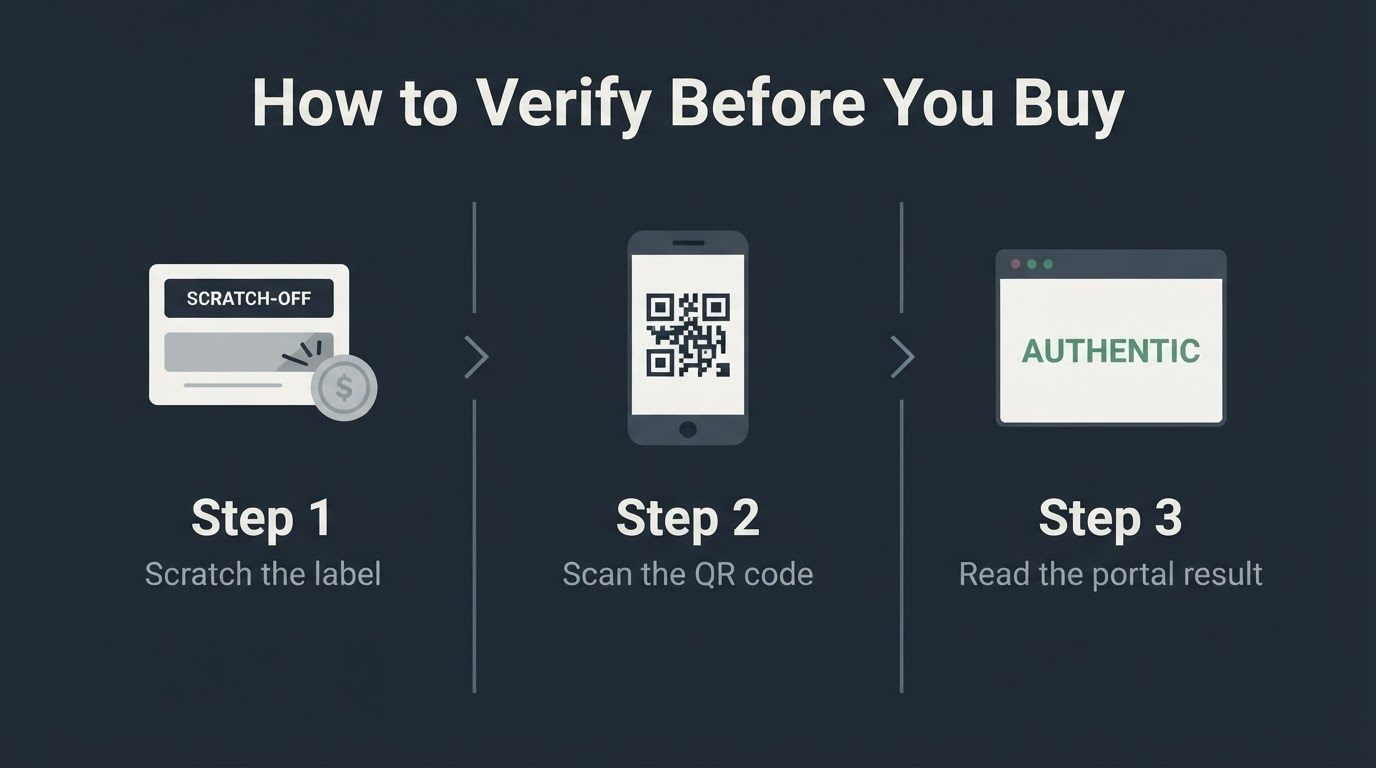
There are two specific things to check on the label before you scratch it. First, the label should show signs of never having been scratched. If the scratch surface shows micro-abrasion, smearing, or has been partially covered with a re-applied sticker, the code has been used. The device may be a genuine unit that was previously verified and then re-sold, or the original label may have been removed and replaced. Either way, do not proceed without a clean verification. Second, the QR code should be sharp and scannable. A blurred or pixelated QR code is a reprint, not an original.
Stage 3: The Device Body and Build Quality
After the packaging and label, hold the device itself. This is where clones that pass the box test often fail.
Weight is the fastest check. Genuine pod systems and box mods are designed to specific engineering tolerances. A clone using lower-grade materials will typically be lighter than the genuine article. This is not always true, as some clones add ballast weight deliberately, but an unexpected lightness is worth registering.
Check every seam and panel join. Genuine devices are manufactured to tolerances that produce flush, consistent joins. Run your finger along the seam between any two panels. On a genuine device, you will feel a consistent gap, or no gap at all. On a clone, you will feel variations: areas where the panels are slightly misaligned, a lip that catches your finger, or a gap that is wider at one end than the other. The mouthpiece-to-body join is a particularly reliable test point.
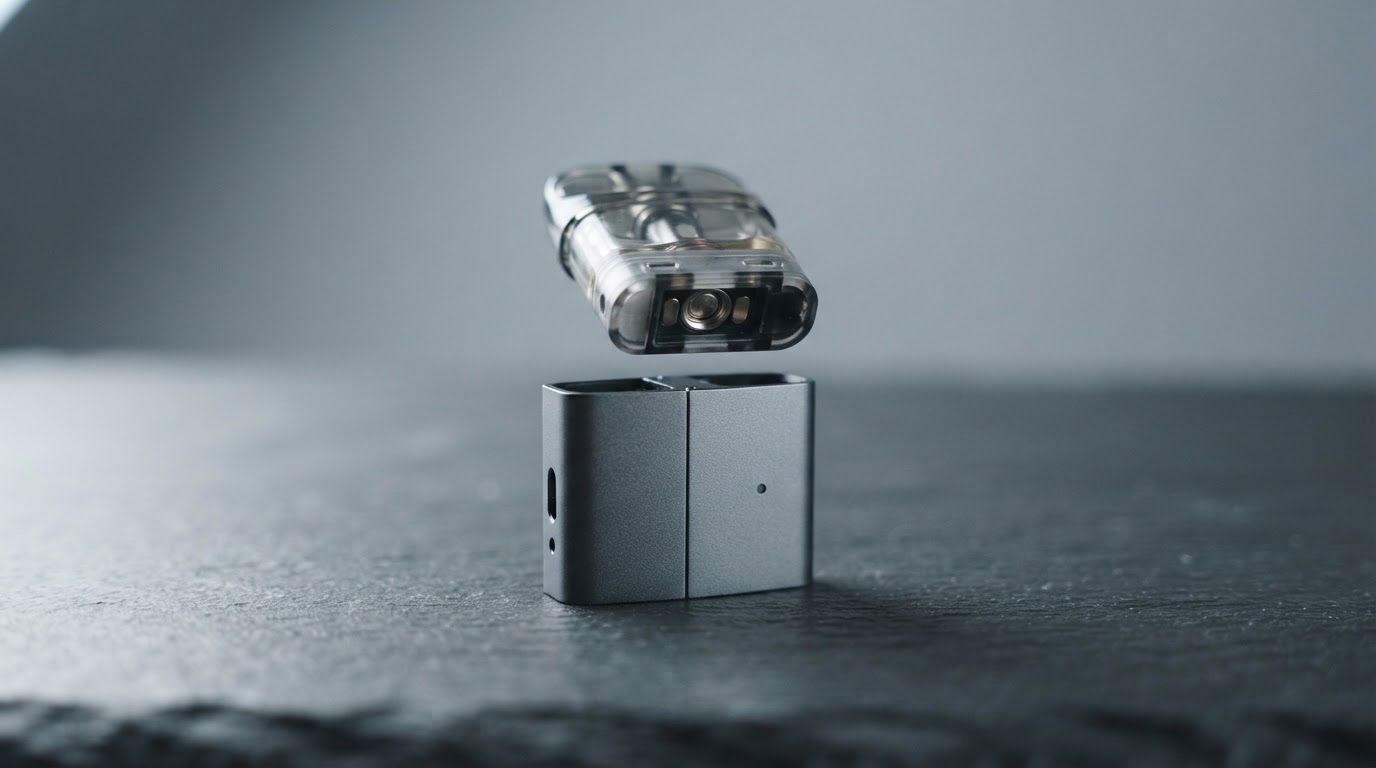
Press every button. On genuine hardware, button travel is consistent, the actuation point is clear, and the button returns fully and cleanly. On clones, buttons are often described by their users as “mushy” or requiring more travel before the device fires. A double-click that registers as a single click, or a fire button that requires unusual force, are both indicators.
Check the coil or pod seat. The tolerance between a genuine coil or pod and its seat is engineered for a specific fit. A genuine coil should seat with a defined resistance and click. A counterfeit pod seat that accepts the coil loosely, or requires force that distorts the device body, is not built to spec. Loose coil seating causes the two most common failure modes of grey-market hardware: leaking into the airflow path and inconsistent heating.
Stage 4: Chipset Behaviour After First Use
Some clones pass the physical inspection well enough to survive a first-impression check. The chipset is where they fail.
Genuine regulated devices from Vaporesso and Uwell operate within documented wattage windows and carry safety cutoffs: short-circuit protection, over-discharge protection, and overtemperature protection. These cutoffs exist because they are required by the quality standards the brands build to. A counterfeit chipset may replicate the screen and the menu interface but will not replicate the underlying protection logic with the same accuracy.
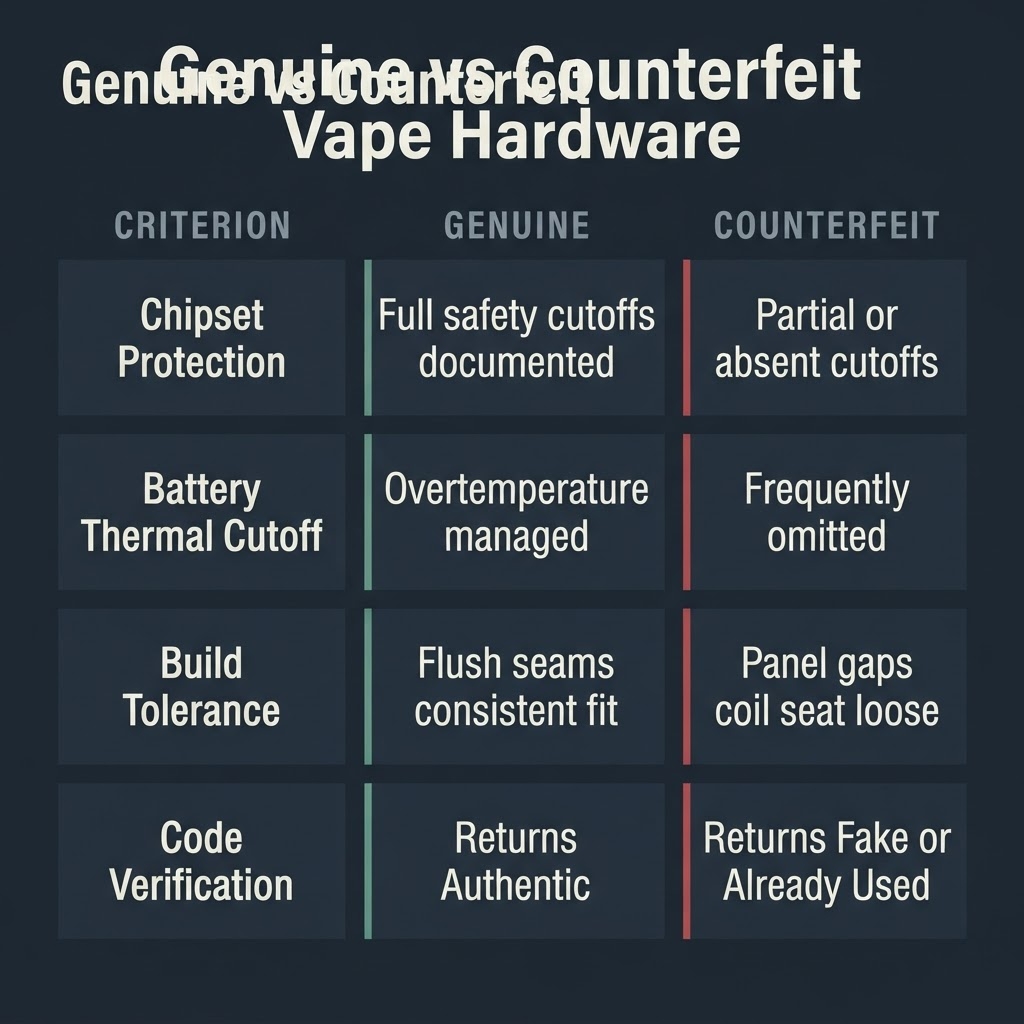
The US Food and Drug Administration notes on its vape battery safety page that battery-related issues appear to be a contributing factor in vape fires and explosions, and recommends using only batteries recommended for your device. A counterfeit device may contain a lithium-ion cell that does not meet the protection standards of a genuine unit. A 2023 study published in PMC confirmed that counterfeit lithium-ion cells frequently lack thermal protection features, making them prone to overheating under off-nominal charging conditions that a genuine cell would manage safely.
On first use, note the following: Does the wattage output feel consistent with the setting, or does it vary noticeably between draws at the same setting? Does the device fire immediately and consistently, or does it occasionally require a second press? Does the menu or display behave as described in the manufacturer’s published documentation? A counterfeit chipset often has non-functional menu items, incorrect readings, or a screen that does not match the documented user interface. Check the manufacturer’s user guide against what you see on the device. Any divergence is a flag.
The Counterfeit Coil Problem: A Separate Category
Counterfeit hardware is one risk. Counterfeit replacement coils and pods are a separate and arguably more common one, because a buyer who verified their device as genuine at purchase may later buy a fake coil from a lower-cost source without realising it.
Counterfeit coils typically fail in three specific ways: the resistance value printed on the coil body does not match the actual measured resistance; the wicking material is insufficient for the claimed wattage range, causing dry hits and accelerated coil burnout; and the coil housing tolerances are slightly off, which causes leaking at the coil-to-pod junction.
The print on a counterfeit coil is the first check point. The resistance value, brand logo, and coil code should all be sharp and consistent. A slightly blurred resistance marking is not acceptable on a precision component. Buy replacement coils from the same authorised source as the device, or verify the seller’s status before ordering.
Inspection Checklist: Eight Checks in Order
| Step | What to Check | Pass | Flag |
| 1 | Box print quality | Sharp text, clean colour, correct weight card stock | Blurred edges, washed colour, lightweight card |
| 2 | Font and spacing on packaging | Matches official product imagery | Slight font mismatch, irregular spacing, kerning errors |
| 3 | Authentication label integrity | Label intact, no micro-abrasion on scratch surface | Evidence of prior scratching, re-applied sticker, pixelated QR |
| 4 | Code verification on portal | “Authentic” result returned | “Fake”, “already verified”, or portal error |
| 5 | Device weight | Within expected range for model | Noticeably lighter or unexpectedly heavier than documented |
| 6 | Seam and panel alignment | Flush, consistent joins throughout | Visible misalignment, catching lip, inconsistent gap |
| 7 | Button travel and return | Clear actuation, consistent feel, clean return | Mushy feel, inconsistent firing, double-click errors |
| 8 | Coil or pod seat | Defined fit, correct resistance click | Loose seating, distortion, leaking on first fill |
Where to Run the Verification
For Vaporesso products: vaporesso.com/is-your-product-authentic. Scratch the label, scan the QR code, or enter the 12-digit or 14-digit code manually. Do not enter the code more than five times.
For Uwell products: myuwell.com/verify. Scratch the coating on the authentication sticker, then enter the 18-digit code or scan the QR code.
Both portals return a clear result in seconds. Run this check before you open the device beyond the packaging, while you can still observe that the label was intact on arrival.
We stock genuine, authorised Vaporesso and Uwell products. You can run the same verification process on anything you purchase from us. If a code from a KandyVape purchase returns any result other than authentic, we want to know. That is not a returns process, but it is a direct accountability check we stand behind.
A Note on Price and What the Gap Actually Represents
If you have seen the same device listed at a price significantly below what authorised retailers charge, the gap does not represent a better deal. It represents the components that were removed or substituted to reach that price: the genuine chipset, the authentic safety systems, the real wicking material, and the import documentation that confirms the unit entered the country through a legal, traceable chain.
KandyVape dispatches orders daily at 3:00 PM, including weekends. Orders above 3,500 BDT qualify for free shipping. Delivery charges below that threshold, and delivery windows for both Dhaka and outside Dhaka, are listed on Shipping and Delivery policy page]. Specific current prices for the devices we stock are listed on each product page, and we do not publish a price in this article that we cannot stand behind with an actual stock unit.
FAQ
Q: Can I verify a vape’s authenticity before I pay, while the seller is present?
Yes, and you should. The Vaporesso and Uwell portals return a result in seconds on a mobile browser. Ask the seller to allow you to scratch the label and run the code while you are still at the point of sale. A genuine seller will not object. A seller who refuses that step is answering your question without words.
Q: What happens if the verification code returns “already verified”?
This means the code was previously submitted to the portal. It could mean the unit is genuine but was verified by a previous buyer or distributor, or it could mean the label has been re-applied to a clone. Either way, the provenance of that specific unit is not clean. Do not proceed on the basis of an “already verified” result alone. A genuine authorised retailer can provide documentation of the supply chain on request.
Q: Are fake vape batteries actually dangerous, or just lower quality?
They can be both. A counterfeit lithium-ion cell does not necessarily fail on its first charge cycle. The risk is in off-nominal conditions: overcharging, over-discharge, or physical damage. Genuine cells carry protection circuitry designed to manage those conditions. Counterfeit cells frequently omit or simplify that circuitry, which is why the US FDA specifically addresses battery-related safety failures in its vape guidance. The failure mode, when it occurs, is thermal.
Q: What is the most commonly counterfeited type of vape hardware in Bangladesh?
Pod systems, specifically compact closed-system pods, are the most commonly cloned category. They are simple enough to replicate mechanically, high enough in demand to make volume counterfeiting profitable, and priced in a range where a 30 to 50 percent discount still looks plausible to an uninformed buyer. Replacement coils and pods are the second most common category.
Q: If I order from KandyVape and the device does not suit me, can I return it?
KandyVape operates a strict no-return and no-refund policy on all products. This is why the article you are reading exists. We would rather spend 2,000 words making sure your first choice is correct than have a customer pay for something that does not work for them. Read the before ordering. If you are uncertain about compatibility, contact us before completing the purchase.
Q: How do I know when an order placed with KandyVape will dispatch?
Orders are dispatched daily at 3:00 PM, including weekends. An order confirmed before 3:00 PM on any day will dispatch that same day. Delivery windows and charges by location are listed on the shipping page.
Q: Do I need to check coils and pods separately, or just the device?
Separately. A genuine device paired with a counterfeit coil will perform poorly and may damage the pod seat over time. If you bought the device from an authorised source but later sourced coils elsewhere, the checklist in Stage 1 of this article applies to the coil packaging as well. Check the print quality, the resistance marking, and the coil code against the manufacturer’s documented coil series for your device.
Before You Order
If you are not certain whether a device or coil is compatible with what you already own, the right time to ask is before the order, not after. Our shop at Shop #22, Level #3, Sahabuddin Plaza, Adabar, Mohammadpur 1207, Dhaka is open for in-person inspection of devices before purchase. You can handle the unit, run the verification code yourself, and check the coil seat before any money changes hands. For online orders, the product pages carry current BDT pricing and compatibility information. Orders above 3,500 BDT ship free.